
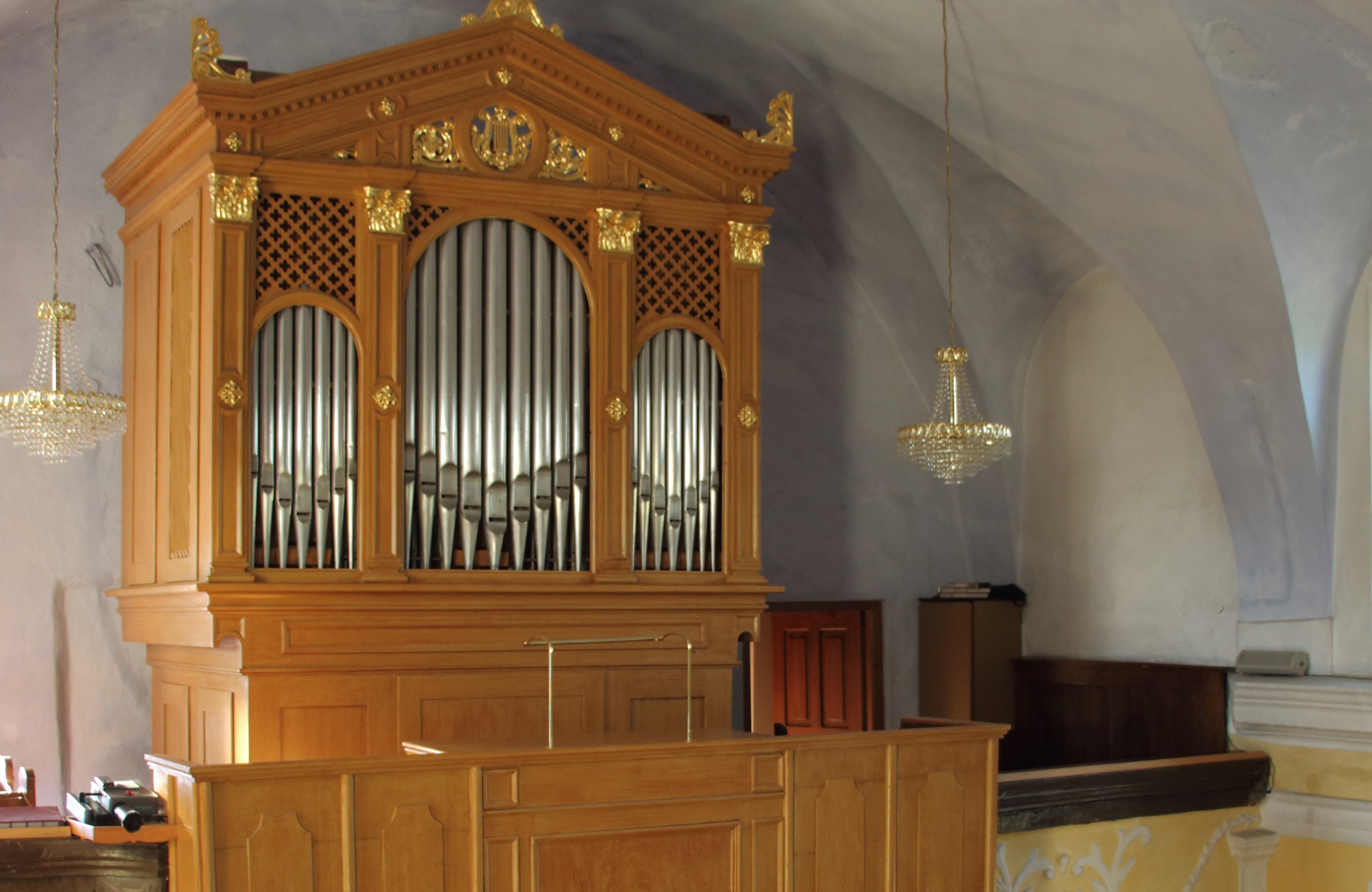
Franc Goršič’s organ at Polica, dating from 1868, belongs to master’s earlier oeuvre, while he still made organs with slider chests. This organ is his 9th work, it has a distinct “pre-Walker” sound, influenced by his teachers and predecessors, Rumpel and Hesse. The term “pre-Walker” is indicated by the 10-register disposition and the almost classical, richly consonant intonation. Goršič has several faces, depending on the different periods of his work, but all of them are convincing.
The sound and technical treatment of the pedal, which repeats the so-called South German tradition, and the mechanics, which are very simple in the old way (today often called “Italian”), are also special, yet very precise. Similar mechanics were made between 1300 and 1800 by Italian and South German craftsmen. Such mechanics are a good way of encouraging a measured finger stroke, as rough, inappropriate playing causes serious rattling. The measurements of Goršič’s keys are also interesting, showing that the piano-like long key shape was not universally accepted even towards the end of the 19th century.
The organ’s distinctive feature is the ‘third hand – terza mano’, which refers to the octave coupler in the manual’s discant, originated in Italian organ-making in the late 18th and 19th centuries. Goršič’s technical solution is sympathetically simple.
Taken from the text by Dalibor Miklavčič
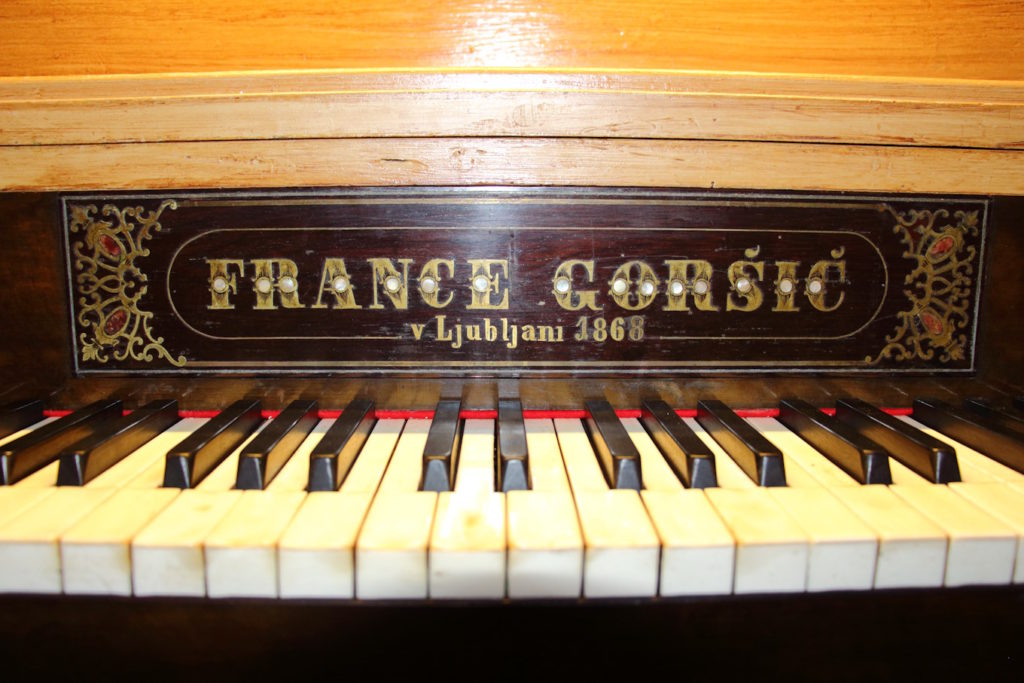
Photo: Organistica
In September 2020, as part of the project of researching the Franc Goršič organ legacy, we documented the organ in the parish church of St. James at Polica near Grosuplje.
Scope of documentation
Technical documentation included the following measurements:
- basic dimensions of the church, choir, organ case, and console
- tuning and temperature
- wind system
- windchests and the pipes arrangement on the windchests
- measurements of the pipes and pipe scales
Sound documentation of the instrument
Photodocumentation of the individual parts and details of the organ
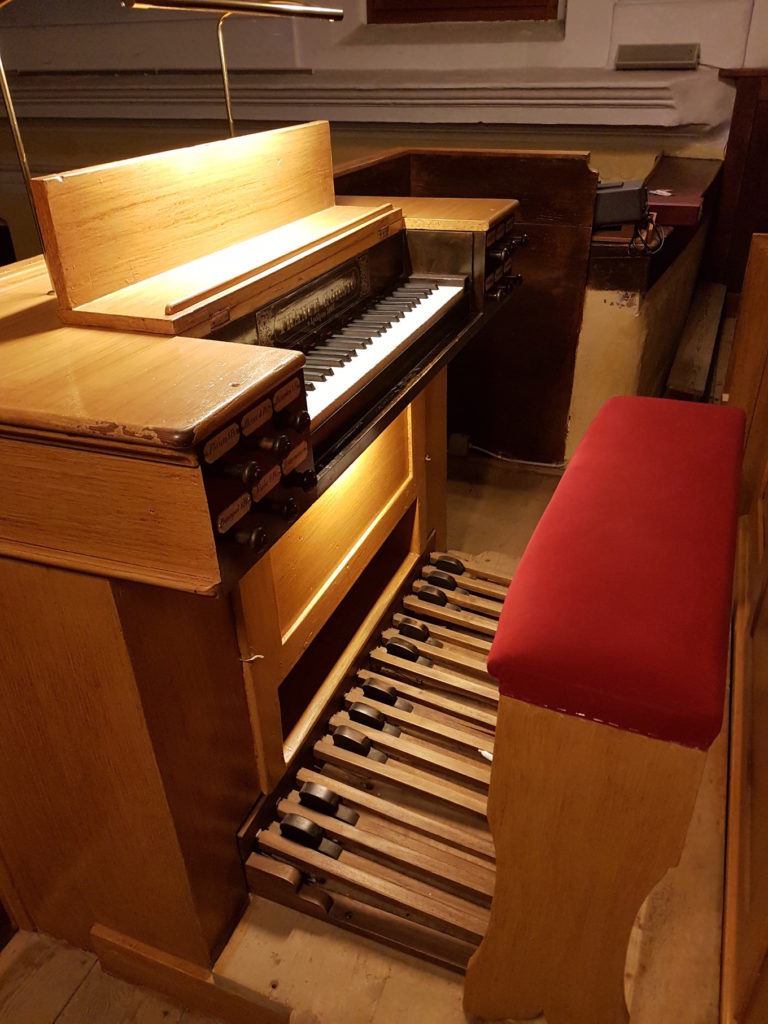
Photo: Organistica
Data and findings
Documented: September 3, 2020
Number of pipes: 528 (wood: 172, metal: 356)
The organ is mechanical with a slider chest:
- Number of windchests: 2 (manual: 1, pedal: 1)
- Wind pressure: 61 mm water column
- Tuning: a1 = 431,2 Hz pri 20 °C
- Wind system: double bellows with onefeeder bellows (electric blower, Könyves Ferenc és Fia Györ, Type: LVM-008080/ 380, 80 mmWS, 8cbm/ min)
The following modifications to the organ are known:
- From a letter sent on October 19, 1913 by Jože Švigelj, parish priest at Polica, for Premrl’s Statistics of the Organs of the Ljubljana Diocese, we learn that the organ has undergone three repairs. The first repairs were carried out in 1890 by Valentin Kos, in 1911 by Ivan Milavec and in 1916 by Ivan Naraks. The organ was not deprived of its prospectus pipes during the First World War.
- The organ was restored to its original condition in 2006 by the Bishop’s Organ Workshop from Hoče near Maribor. It was restored and sung again on the 170th anniversary of the birth of Franc Goršič.
Notes:
- Some of the wooden and metal pipes are not original.
- The Bourdon 8′ and Flavto traverso 4′ manual registers and the Subbass 16′ pedal register were reconstructed at the time of restoration.
- The pedal tracker from c0-h0 octave repeats C-H.
Dispozicija orgel
| Manual (C – g3) | Material |
| Principal 8’ | wood: C-GIS, metal: A-g3 |
| Flauto 8′ | wood: C-h0, metal: c1-g3 |
| Viola 8′ | wood: C-h0, metal: c1-g3 |
| Bordun 8′ | wood |
| Octav 4′ | wood: C-D, metal: DIS-g3 |
| Flauto traverso 4’ | wood |
| Superoctav 2′ | metal |
| Mixtur II 1 1/3′ | metal |
| Pedal (C – h0) | |
| Subbass 16′ | wood |
| Octavbass 8′ | wood |
| Pedalcoppel | |
| Octavencoppel (gis1 – g2) | |
Mixtur II 1 1/3′
| C | c0 | c1 | cis2 | fis2 | cis3 | g3 | |
| Vrsta I | 1 1/3′ | 1 1/3′ | 1 1/3′ | 1 1/3′ | 2 2/3′ | 2 2/3′ | 2 2/3′ |
| Vrsta II | 1′ | 1′ | 1′ | 2′ | 2′ | 4′ | 4′ |


