
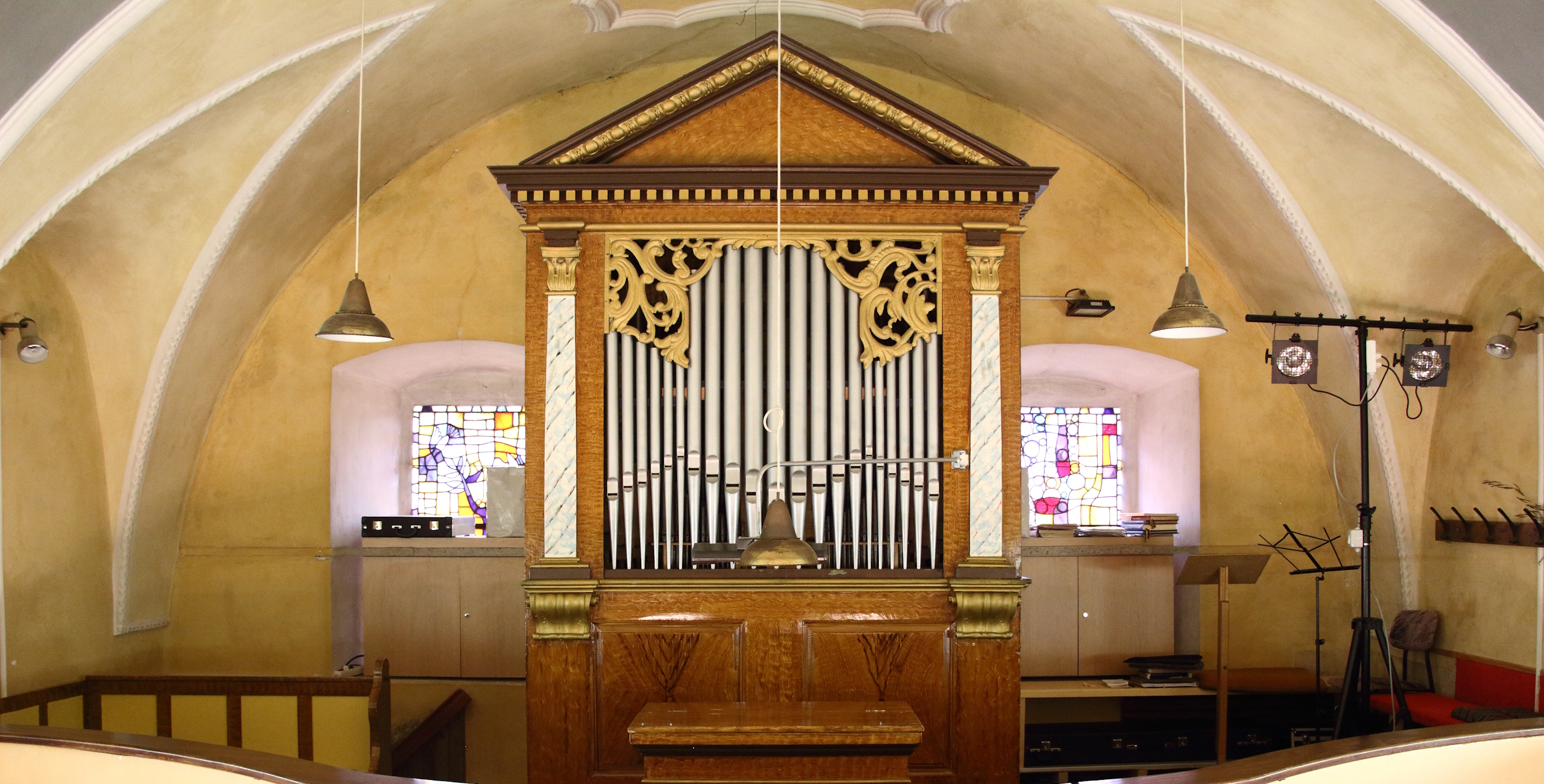
As part of the project of researching the Franc Goršič organ legacy, we documented the organ in the parish church of St. George in Izlake in August 2020. This historic organ, crafted in 1850, is attributed to the renowned organ builder Peter Rumpel (1787-1861) from Kamnik. Franc Goršič worked as an apprentice under Peter Rumpel for five years, from 1850 to 1855.

Photo: Organistica
Scope of documentation
Technical documentation included the following measurements:
- basic dimensions of the church, choir, organ case, and console
- tuning and temperature
- wind system
- windchests and the pipes arrangement on the windchests
- measurements of the pipes and pipe scales
Sound documentation of the instrument
Photodocumentation of the individual parts and details of the organ

Photo: Organistica
Data and findings
Documented: August 7, 2020
Number of pipes: 476 (wood: 108, metal: 368)
The organ is mechanical with a slider chest:
- Number of windchests: 2 (manual: 1, pedal: 1)
- Wind pressure: 70 mm water column
- Tuning: a1 = 253,0 Hz at 12,2 °C, humidity 65 % (November 21, 2022)
- Wind system: double bellows with onefeeder bellows (electric blower)
The following modifications to the organ are known:
- The organ originally had the Mixtura II 1′ register, which was replaced over time (by an unknown organ builder) by the Piccolo 1′ register.
- Originally, the organ had one windchest with manual and the pedal Octavbas 8′ register, which was replaced by the Subbas 16′ register on a new pedal windchest behind the organ case when the organ was rebuilt in 1992 (Maribor Hoče Organ Workshop).
- Most of the wooden pipes were replaced when the organ was rebuilt.
Notes:
- Judging from the variety of signatures and signs of the pipe treatment, the authenticity of the instrument is questionable.
- The original scale of the manual keyboard (short octave (C/E – f3)) is also questionable.
- The painting of the organ case is not authentic.
Organ disposition
| Manual (C – f3) | Material |
| Principal 4’ | metal |
| Bordun 8′ | wood: C-h0, metal: c1-f3 |
| Salicional 8′ | wood: C-H, metal: c0-f3 |
| Flavta 4’ | C-H transmission from Salicional 8′, wood c0-f3 |
| Vox coelestic 8’ | metal: e0-f3 |
| Kvinta 2 2/3’ | wood: C-H, kovina: c0-f3 |
| Oktava 2′ | metal |
| Kvinta 1 1/3’ | metal |
| Pikolo 1′ | metal |
| Pedal (C – f0) | |
| Subbas 16’ | wood |


