
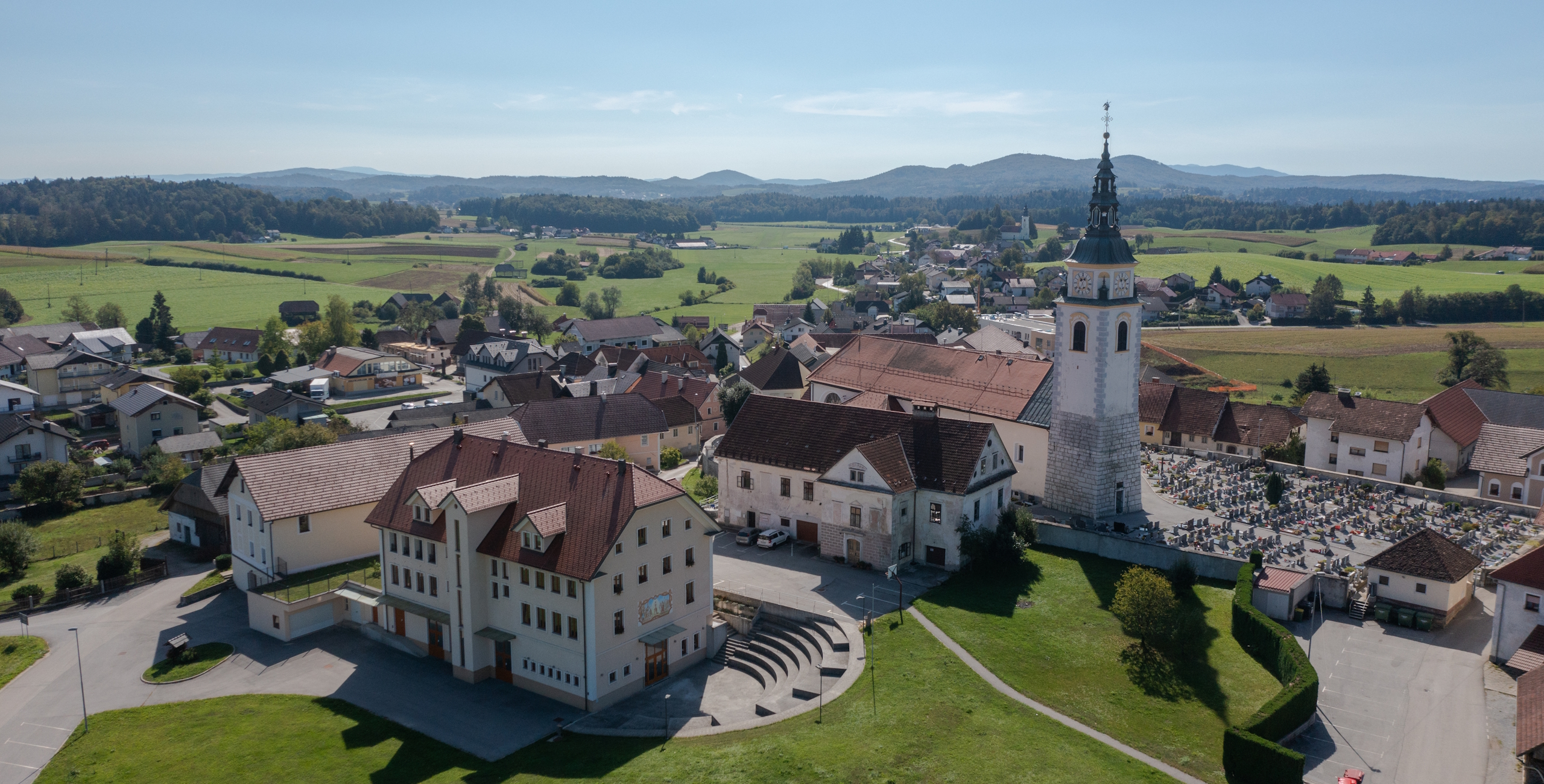
Šentvid pri Stični is one of the most important initial parishes in Slovenia. The first documented record of the parish of Šentvid dates back to April 15, 1016, when Emperor Henry II, at the request of his wife Kunigunda and through the mediation of the Archbishop of Cologne and the Bishop of Bamberg, granted the Count William II of Savinja extensive estates in the area of the County of Savinja. In 1132, the Patriarch of Aquileia, Peregrin I. (? – 1161), the founder of the Cistercian monastery in Stična, handed over the parish of Šentvid to the monks of Stična until the monastery was completed in Stična. Important information about the size of the parish at that time is recorded in the foundation document of the Cistercian monastery in Stična from 1136. A transcription of the deed of Anton Gallenfels, Abbot of Stična, from 1716, and the Stična chronicler, p. Pavel Pucelj, from 1719, have been preserved.
The oldest sources about the organ in Šentvid pri Stični
Šentvid pri Stični, in addition to its ancient involvement in the history of the region, also boasts a rich musical past. The first organ in Šentvid may have stood on the choir shortly after 1625, when on May 1, the day of St. Philip and St. James, a new altar and church nave were consecrated by the prince-bishop of Trento, Rinaldo Scarlichi (at that time Bishop of Trieste, later of Ljubljana). The nave was extended to the bell tower, and a choir was added. In those days, the building of a choir in churches was often accompanied by the purchase of an organ.
The first known organist at St. Vid was Piero Legat, c. 1697, who signed the back of the main altar of the former St. Vid branch church in Muljava: “Piero Legat Organista di S. Vito 1697” (this inscription can no longer be found after the last renovation of the altar). The explicit reference to there being an organist at St. Vid is a strong indication that there was also an organ at St. Vid.
“The first written evidence of the organ is found in the statement of expenses for May 25, 1738, when an expense to the organ builder for repairs is mentioned. The next record of the organ being repaired is 9 years younger. Which organ it was and what kind, is not known at this time. Perhaps the organ was still the one played by Piero Legat and could be dated with a margin of error to around 1676 or even 1625.”

Photo: Pipe organs in Slovenia, M. Bizjak, E. Škulj
New organ in 1771
The records of the Brotherhood of St. Roch and St. Sebastian, kept in the parish archives, list various costs for furnishing the parish and branch churches. It also records “1771 Organum novum” (new organ in 1771), which was noted by the art historian France Stele in 1926 when he took an inventory of the church. A few years later, the 1780 inventory lists “Ein neue Orgel ungefaßt. 400” among the church furnishings, which means that at that time the church had purchased a new organ, but the organ case had not yet been painted or finished.
The organ from 1771 stood in the choir of the Šentvid church, probably until 1838. What was it like? From a newspaper advertisement announcing that an old, still usable organ was for sale in Šentvid (Intelligenzblatt zur Laibacher Zeitung, February 20, 1838, No 22, p. 123), we learn that it had 10 registers (colours of sound). This organ was bought in 1838 by the parish of St. Trinity above Cerknica, whose chronicle for 1956 gives an estimate of the organ’s age, external appearance and other technical details.
Judging by the description of the organ case and the comparison of the existing organs by the organ builders of the time, the organ could be attributed to one of the organ builders from Kranj: Janez Jurij Eisel (1708-1780) or Josip Kučera (1755-1826). Janeček from Celje could also be a possible candidate, but the low price does not favour him. Based on the decoration, we cannot determine for sure whether the organ was still Eisel’s or perhaps really Kučera’s. The two organ builders were quite close in the style of some of their cases.
Organ from Rumple’s workshop
In June 1838, the parish church in Šentvid received a new organ from the organ workshop of Peter Rumpl (1787 – 1861) from Kamnik. It had 16 registers, divided into 2 manuals and a pedal. The cost of the investment was 500 forints, according to the 1838 inventory. The price for a new 16-register organ was very low at that time. Information about the new organ is indirectly mentioned in a newspaper advertisement for the sale of the old organ: “A new organ will be installed in the parish church in Šentvid pri Stični by mid-June 1838”.
What was Rumpl’s organ like?
We know the appearance of the organ casing, as both cases are still preserved today. Judging by the cut-outs and the asymmetrical layout, the console stood independently between the two organ cases and was aligned lengthwise with the back positive. Rumpel did not make many of these consoles. Two manuals are evident from the positive on the choir fence. The positioning of the positive is somewhat unusual: it was placed tightly in the cut-out of the built choir fence in relation to the supporting pillar, rather than in the axis of the large organ case. Also, the exterior image is not simply a scaled-down duplicate of a large case. It is not surprising, then, that some authors have inferred from the external appearance and the off-centre layout that the two organ cases are not contemporaneous.
In 1884, the organ was repaired by the great Slovenian organ builder Franc Goršič (1836 – 1898). The record in the Kronika and the cost of 235 forints in the treasurer’s diary show that it was not a simple job.

Photo: Organistica
In the last decades of the 19th century and at the beginning of the 20th century, according to the testimony of the then parish priest Vidergar, the old organ in Šentvid pri Stični was breaking down more and more frequently, so in the spring of 1911 he turned to the Mayer brothers’ company for the construction of a new organ.