
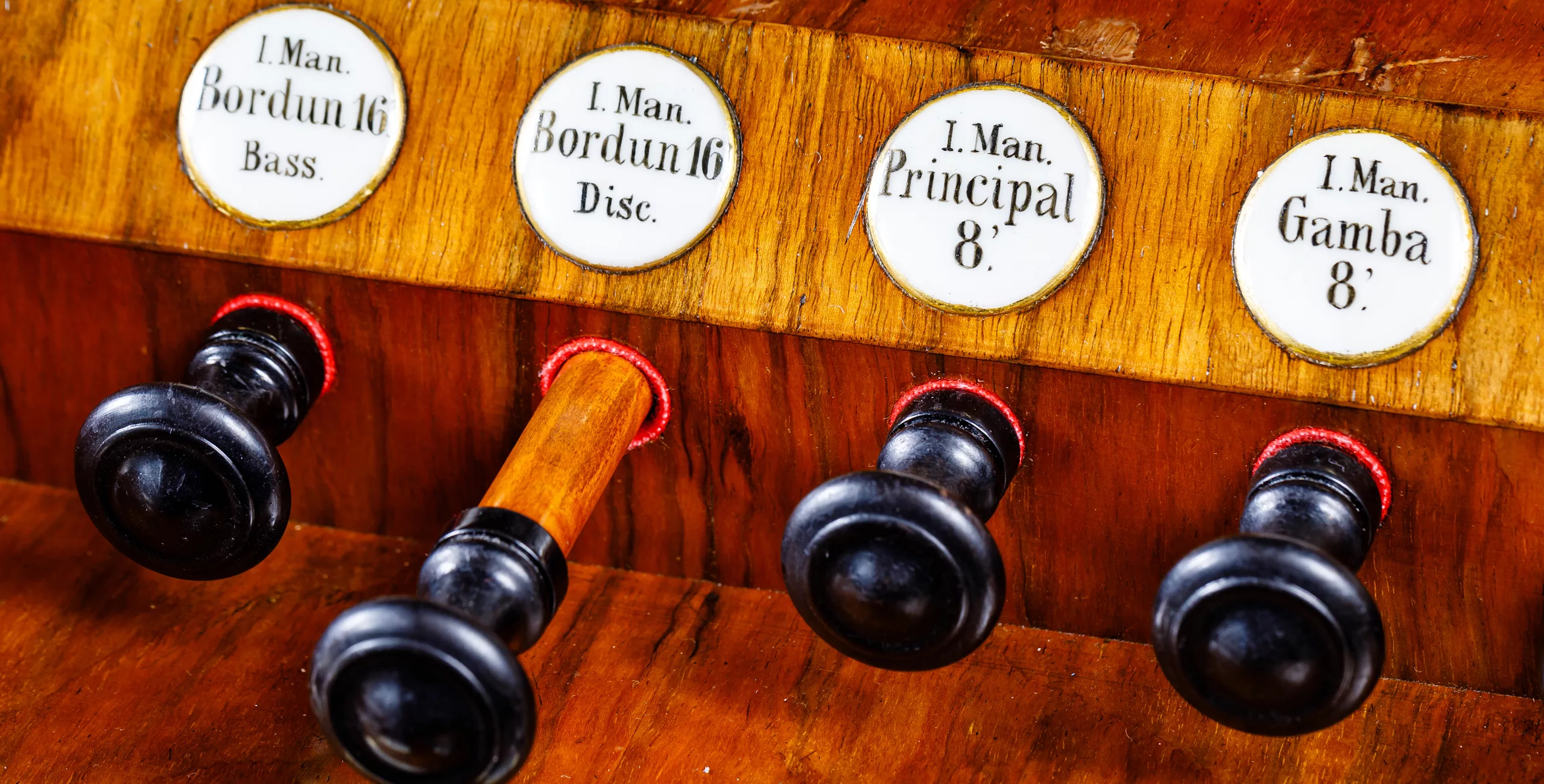
To better understand the work of Franc Goršič, it is necessary to collect and analyse the knowledge that the master acquired during his education and work. We often talk about typical Slovenian intonation. But do we know what exactly this means? What is the Slovene sound supposed to be and what are the Slovene ideas of the sound of the organ in the Romantic period? Can we even call them Slovene, or are they merely the ideas of an individual who brought them to the Slovene sphere by understanding what was happening in the European area at the time?
In 2019, a project of in-depth and systematic research of the master’s works spontaneously developed from the initial amateur visits to Goršič’s instruments around Slovenia. The current estimate of the project’s length is ten years.
We have set ourselves a diverse and wide-ranging project, encompassing an in-depth analysis of Goršič’s oeuvre, a review of existing or undiscovered documentation on his life and work, and the revitalisation of his legacy. At the same time, a continuation of the learning about Goršič is already presented by Dr Edo Škulj in his 2004 book “Goršičeva orgelska delavnica«. Our project’s aim is to find the right information, stimulate further restoration of musical instruments, and ultimately their understanding.
A clear path for the research project
The project implementation is systematically divided into the following strands:
- Development of a system for measuring organ pipes – Determining what to measure for each pipe, systematically describing each organ register, creating technical sketches of each register pipe, and specifying the methods.
- Collecting archival material in Slovenia and abroad on the life of Franc Goršič and his family, colleagues, and organ builders with whom he had contact or from whom he studied (Peter Rumpel, Ferdinand Malahovski, Carl Hesse, Link Organ Workshop, etc.).
- Establishing contacts with Goršič’s descendants and obtaining material from private sources.
- Documenting the technical characteristics of the entire preserved oeuvre of Franc Goršič and his teachers Peter Rumpel and Ferdinand Malahovski. This includes taking detailed photographs of individual organs, measuring the pipe scales, bellows, windchests, console, organ cases, and recording the organ sound.
Today we estimate that Goršič’s entire oeuvre comprises 66 newly made or reworked instruments in Slovenia, Croatia, Austria and Italy.
Working on each opus, which has around 14 registers, takes an average of 12 to 20 hours. So far we have managed to document five Goršič organs and one opus by Goršič’s teacher Peter Rumpel, namely:
- St. Lawrence church in Žalna (Franc Goršič, Op. 3, 1865)
- St. James church in Polica (Franc Goršič, Op. 9, 1868)
- St. James church in Ljubljana (Franc Goršič, Op. 36, 1883)
- Sts. Ingenuin and Albuin church in Koroška Beła (Franc Goršič, Op. 60, 1893)
- Sts. Peter and Paul church in Zagorje ob Savi (Franc Goršič, Op. 62, 1895)
- St. George church in Izlake (Peter Rumpel, 1850)
We would be pleased to examine or analyse a total of 79 organs in Slovenia, Austria, Italy, and Croatia, in addition to Goršič’s organs and those of his predecessors (Peter Rumpel, Ferdinand Malahovski …).
The data obtained through detailed photography and sound recording will serve in the future as a basis for a detailed analysis of the technical development and manufacture of Franc Goršič’s instruments throughout his lifetime.
Consent of the Slovenian Bishops’ Conference
The project is highly significant and time-bound, therefore we have submitted an official request to the Slovenian Bishops’ Conference for permission to visit Slovenian parishes with churches that have preserved Goršič organs. Consent is the basis for concrete agreements with the parish priests to visit these organs and to review any available documentation that may still exist on it.
Consent of the Slovenian Bishops’ Conference
We kindly ask for the cooperation of all priests and organists serving in churches with Goršič organs. Your assistance in providing access to the instruments and related documentation would be greatly appreciated. Additionally, we invite organ builders who have worked on Goršič organs to share any relevant written or photographic materials. This way, we aim to collectively learn from the past as we move forward.