
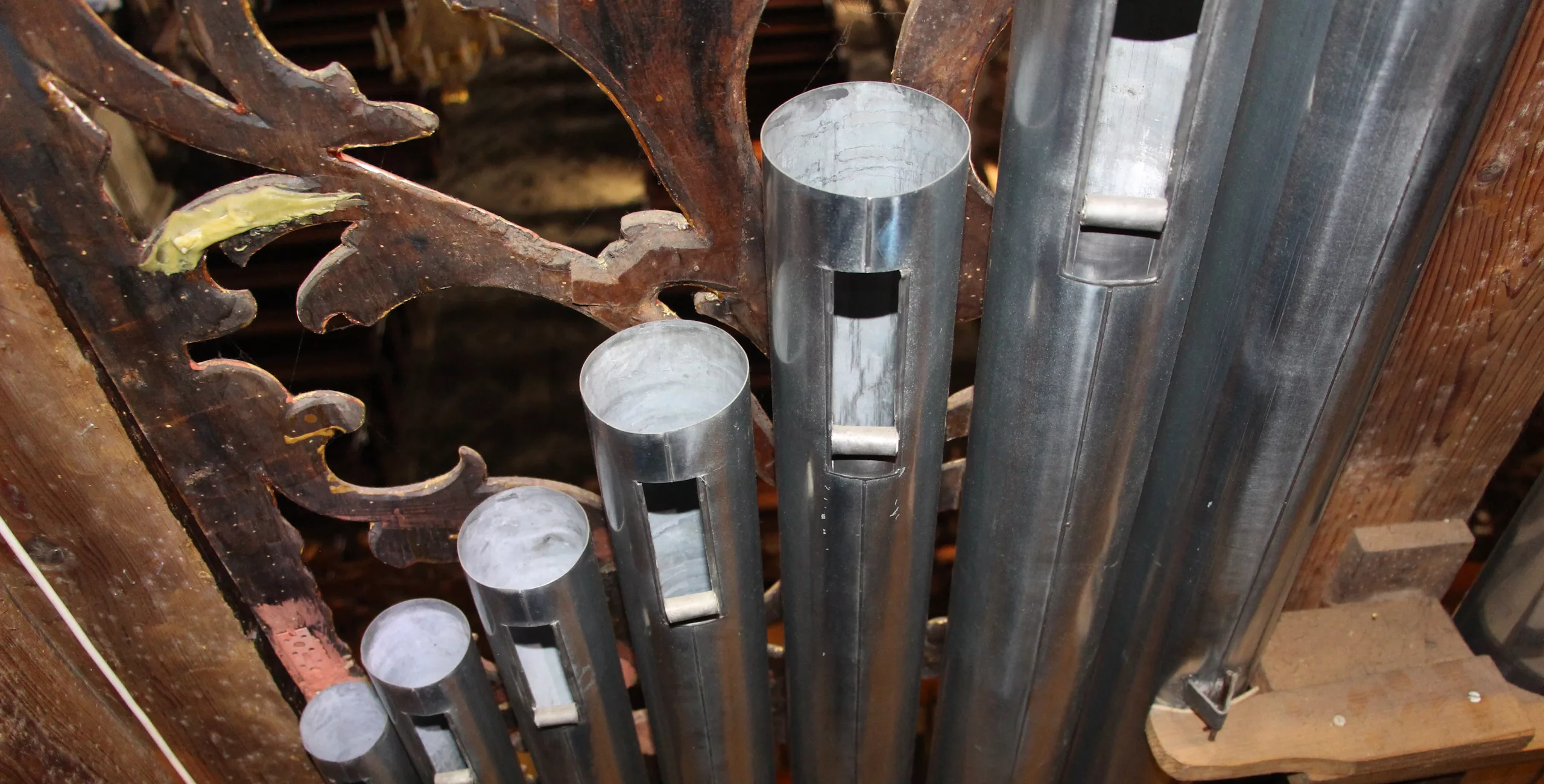
We examined the current organ in the Church of St. James and made detailed measurements of the old pipes that are still preserved. Our aim was to gather information about historical past pipe-making and to rediscover our own, already forgotten culture.
We often underestimate the importance of our own organ culture, which is rich and varied, despite the small size of our country. The Church of St James in Ljubljana, with its organ, is also part of this cultural heritage and played a significant role in cultural events in Ljubljana.
How do we know that Franc Jenko used old pipes for the organ in the Church of St. James in Ljubljana?
Colour
From experience, the colour or oxidation of the pipes is a reliable criterion. The Franc Jenko pipes in this organ (Op. 90, 1960) are generally painted or made of untreated cast iron (Naturguß) and are distinguishable from older, more oxidised pipes made of treated cast iron.
Signature
The next criterion is the signatures or markings of both registers and tones. Jenko was consistent in this respect, as he stamped his own markings despite the use of old pipes. We therefore have both the old and new markings on the old pipes, and we notice that the tone markings are offset (on the pipe with the new marking c1 the old signature is h0). Some of the old register markings do not correspond to the new ones (e.g. on the second row of the 2′-register of the Cimbel there is a q marking, which in principle indicates “kvinta”).
Regulating slots (expressions)
The third criterion is the regulating slots (expressions). It is interesting how they are made. Jenko carved the regulating slots in the old pipes in a flat manner, not in proportionally. In Jenko’s new pipes, we see a continuous relationship between the mensural, the width of the regulating slots and the height of the ring above it. In the reused pipes, these two ratios are quite flatly determined (they change stepwise every two octaves).
Length of pipe foot
The fourth criterion is the length of the pipe foots. Unlike Jenko, who in principle uses the same foot length for all pipes, the lengths of old pipes vary (140, 150, 160, 180, and 190 mm).
Languid angle
The next criterion is the languid angle: there are differences in the density of languids, as well as in the depth and angle. The angle of the languid is a reliable criterion: the Jenko pipes have an angle of 45°, which does not change over the course of the mensure. Measured old pipes have a sharper angle.
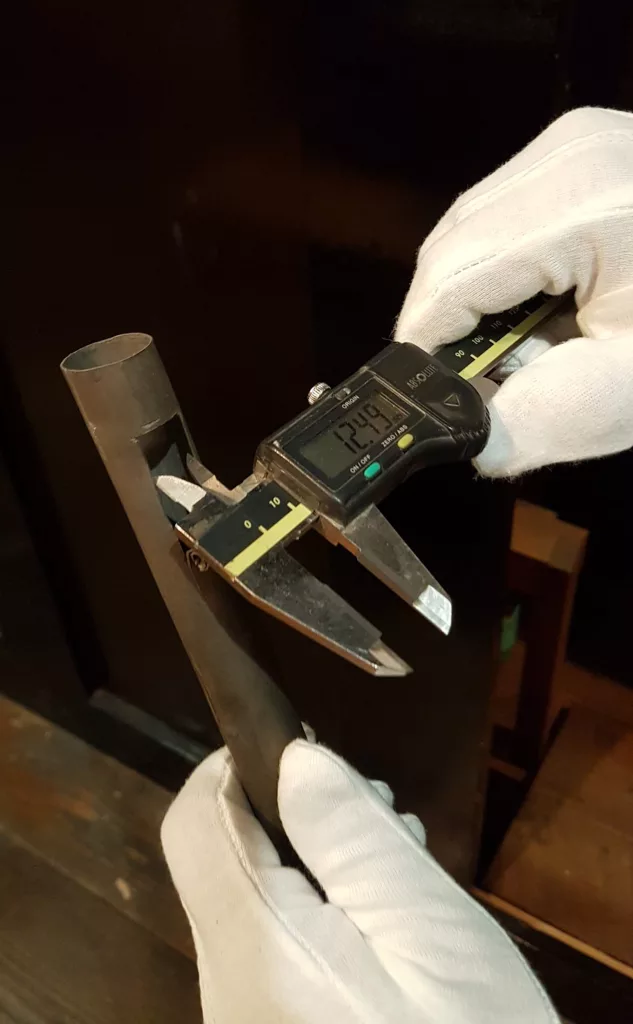
Photo: Organistica
Diameter of the pipe bodies
The last criterion is the diameter or circumference of the pipe bodies, where we observe a divergence of the old mensuras from the standard Jenko mensuras. Comparisons will only be possible after reference analyses have been carried out on the instruments of Eisel, Malahovski, Goršič and Jenko.
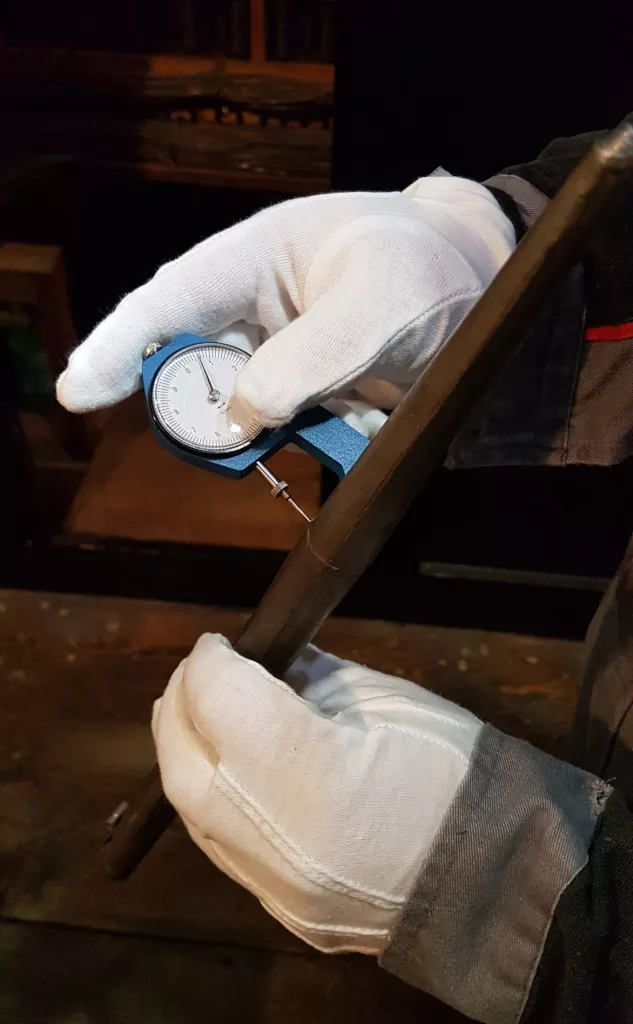
Photo: Organistica
Based on the results of these criteria, it can be assumed that Jenko also used material from other organs for the new one. Thus, there is a high probability that Jenko’s organ contains old pipes by Eisel, Malahovski, and Goršič as well as from other masters.
For example: Principal 8′ (I. manual): the tone c1 has the mark b0, with a signature of 4′ on the upper lip of the pipe. The languid is thicker at the windway, which does not correspond to Eisel’s style. Languid angle does indeed correspond to Franc Jenko’s style, but the pipe is older. Neither the welds nor the nicks correspond to the style of Malahovski, nor Goršič’s manufacturing style.


