
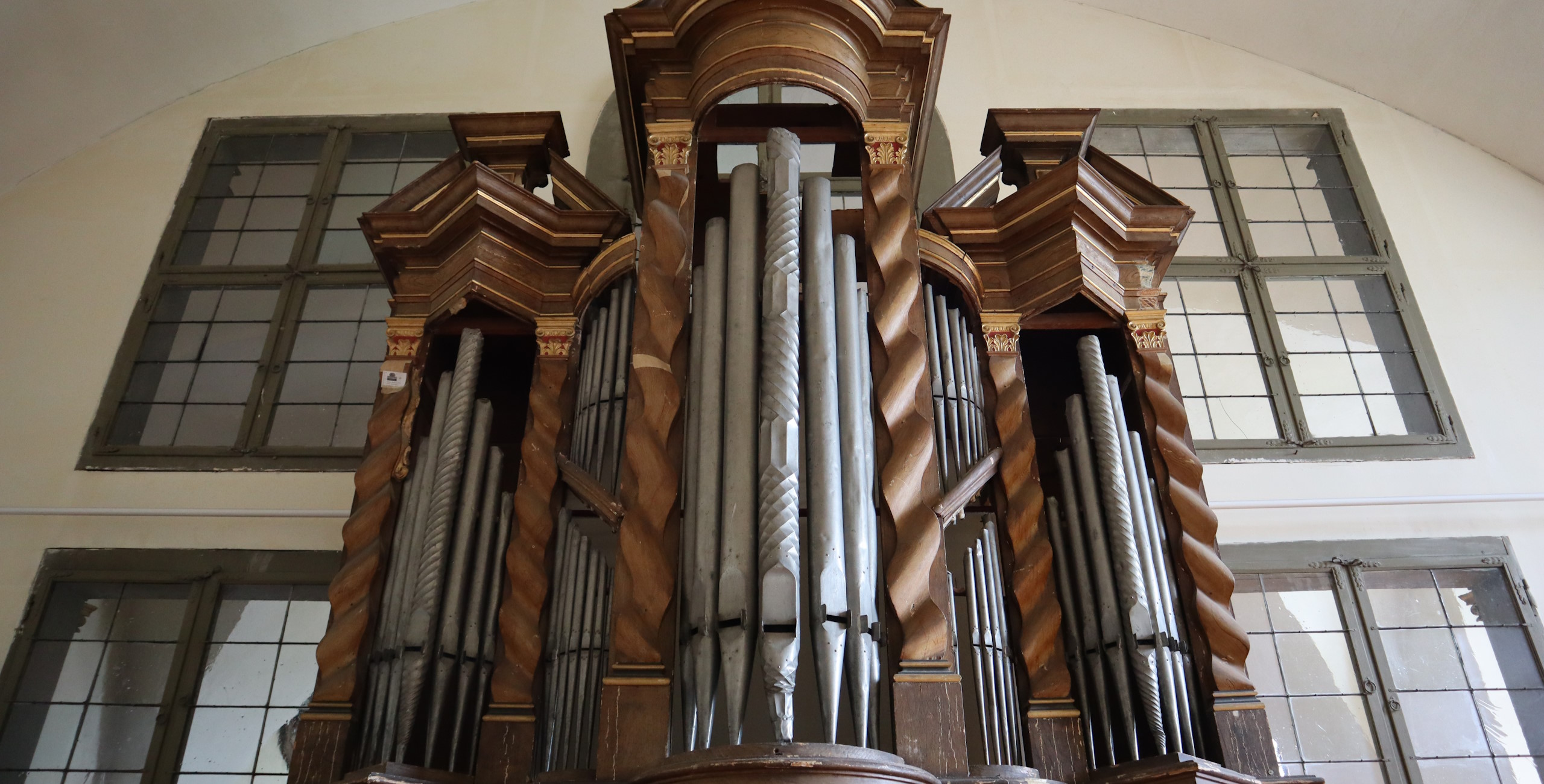
Until 2008, an organ dating back to 1720 was used to accompany church singing in the choir loft of the parish church of Mary of the Assumption in Mekinje, near Kamnik. Over the years, this organ underwent many alterations but retained its original external appearance, including a unique organ case and a significant portion of its original pipes and windchests. After nearly 290 years of use, the organ became worn out and was in need of a complete renovation. It has been stored since being replaced in 2009 by a new organ made by the Anton Škrabl Organ Workshop from Rogaška Slatina, with plans for its renovation in the future.

Foto: Cerkveni glasbenik, 1927, Vol. 50, No. 11-12, p. 211
History of the organ in Mekinje near Kamnik
The construction of the old Mekinje organ in 1720, during the time of Doroteja Sidonija Gallenberg (1664–1728), abbess of the Mekinje Clarissan convent, is attributed to organ builder Janez Mihael Steinhofer. The connection between the author and his opus is not explicitly stated anywhere, but the conclusion follows from two assumptions: the author of the organ in Goče near Vipava is the same as in Mekinje, and the author of the Goče organ is Janez Mihael Steinhofer.
A similar organ case has been preserved, but only in a photograph, located in Goče near Vipava. According to information from Premrl, this organ was built by the Ljubljana organ builder Janez Mihael Zajc in 1734. However, since Premrl did not provide a source for this information, we cannot verify it today. Despite systematic examinations of archival material and parish registers, we have not yet confirmed the existence of Janez Mihael Zajc in Ljubljana. We do know of another organ builder, Janez Mihael Steinhofer, who was active in Ljubljana between 1723 and 1729. It is highly likely that Zajc (also referred to as Saiz or Seitz) and Steinhofer were the same person. Furthermore, it is even more probable that the builder of the Goče organ is the same master who constructed the organs in Mekinje. Similar organ cases are not found anywhere else in Slovenia.
Milko Bizjak, Orgle na slovenskem (Organs in Slovenia), 1985

Foto: author unknown
The old Mekinje organ is renowned for its ornate Baroque case, featuring intricate sculptures, carvings, and richly decorated pipes. This makes it a remarkable standout in Slovenia, especially when compared to other similar instruments from that era that have been preserved.
The organ was placed on a wooden extension of the brick and vaulted choir loft, positioned between a former wall with decorative windows and a high railing on the choir loft. On the front side, it had a playing niche equipped with two manuals and a pedal, allowing the organist to face away from the altar. Twenty register drawstops were symmetrically arranged on either side of the playing niche. The windchest of the main manual was located above the windchest of the positive, which had its own 2′ prospect. Presumably, the organ originally had 11 registers on the main manual, 6 on the positive, and 3 on the pedal. Additionally, the presence of openings for drive belts suggests that there were originally three bellows.
The organ case is an example of early Baroque design, featuring three larger and four intermediate pipe fields. The central field is oval in shape, while the side fields are triangular. The intermediate pillars are arranged in a mirrored arrangement that resembles a massive spiral. Each pillar has a capital at the top and a simple base at the bottom. The central pipes, including the feet, are adorned with embossed spiral patterns. The largest pipe showcases a double spiral design, creating a network interrupted in three places by a polygonal tube. The other pipes on the front display triple punches above and below the mouth. Tuning ears were added later. Above the pipes, the decoration is gilded and culminates in an angel’s head at the junction. Unlike the case in Goče, which has been removed, the central field features square-ended carved decoration, while the side fields have a more rounded design. The statues atop the cabinet are now polychromed and include four angels with (presumably) musical instruments, St. Rosalia, St. Cecilia, and King David holding a harp at the top. The mesh railing on the choir loft is believed to be contemporary, and the entire ensemble is attributed to the same Franciscan school as the main altar, which also dates from 1720.
Emilijan Cevc, Ecce Organum, 2017, No. 7

Foto: The parish of Mekinje near Kamnik archive
Historical sources indicate that the organ was repaired in 1836, tuned in 1856, and fitted with new bellows.
In 1891, the Zupan brothers, organ builders from Kamnik, undertook significant renovations on the instrument. They created a new console with a pedalboard that faced the presbytery. The new pedal pipes were installed at the location of the corner altar and covered with boards, which reduced the number of registers from 20 to 16.
The work on the organ was completed in 1899 by Andrej Hrastnik, a former assistant in the Franc Goršič’s organ workshop. His contributions included moving the pedal to the wall (which shortened the mechanism), drilling a hole in the wall next to the pedal, installing a new pedal case, replacing the Kornet register with the Rohrflöte in the II. manual, and adding the Gamba register to the I. manual. During this process, he replaced, repaired, and tuned several pipes from various registers. In 1901, Andrej Hrastnik also tuned the organ.
In May 1910, Ivan Milavec tuned the organ. In 1913, he repaired it, tuned it again, and covered the bellows with new leather. In 1915, during World War I, the organ was damaged by soldiers; however, it was spared from being requisitioned for military purposes.
After World War I, the old Mekinje organ underwent a series of interventions and modifications:
- In November 1920, Franc Jenko tuned the organ.
- In April 1925, an electric motor was installed for the organ. The bellows were adapted for this purpose and were almost entirely covered with new leather. Josip Brandl carried out this work.
- In May 1927, Franc Jenko repaired, cleaned, and tuned the organ. He also repaired the motor and installed a new Viola 8′ register, replacing the Rohrflöte 4′ in the II manual. He pneumatically connected some of the pipes to the new wind chest. Additionally, four wooden pipes in the Gedeckt 8′ register and two metal pipes in the Salicional 8′ register, both in the I. manual, were replaced. New inscriptions for the registers were created.
- In June 1938, Franc Jenko cleaned and tuned the organ, repairing around five wooden pipes in the process.
- In September 1947, Andrej Benda repaired, cleaned, and tuned the organ. He coated the smaller wooden pipes with woodworm varnish and soldered some of the metal pipes.
- In April 1951, Andrej Benda installed a new 8′ Concert Viola register and extended the organ case by 45 cm.
- In April 1953, Franc Jenko repaired the register.
- In April 1960, Franc Jenko repaired the bellows and adjusted the pipes.
- In September 1963, Andrej Benda tuned and repaired the organ.
- In December 1966, Anton Rogelj, a former colleague of Franc Jenko, repaired the pedal and the second manual. He lubricated and temporarily muffled the wooden pipes in the II. manual.
- In July 1967, Anton Rogelj continued his work by repairing the Concert Viola 8′, reopening the previously closed register, removing dust, and improving the operation of the electric motor.
- Until 2008, Jože Kočar was responsible for the maintenance and repair of the organ.
- In 2008, the Škrabl Organ Workshop dismantled the old Mekinje organ and moved it to the parish premises. A year later, it was replaced in the choir loft by a new organ made by the Škrabl Organ Workshop.
What are the future plans for the old Mekinje organ?
The old Mekinje organ remains dismantled and stored in the parish premises. This year, organist Peter Jereb has brought attention to it. Recognizing the significance of Slovenian organ cultural heritage, he has decided to research this valuable historical instrument in more detail and explore the possibilities and conditions for its reconstruction. Other organ experts are also offering their professional knowledge to assist him. Among them are experts from Organistica, who are advising him on how to document the organ using their expertise and systematic approach, and supporting him in this challenging research project.

Photo: Peter Jereb
Organ disposition
The book Orgle na Slovenskem (Organs in Slovenia) from 1985 lists the following disposition of the old Mekinje organ, which remained unchanged until 2008:
| I. manual | II. manual | Pedal |
| Principal 8′ | Borduneck 8′ | Subbass 16′ |
| Gedeckt 8′ | Viola 8′ | Octavbass 8′ |
| Principal Flöte 8′ | Flavta 4′ | |
| Salicional 8′ | Picolo 2′ | |
| Octav 4′ | ||
| Flöte 4′ | ||
| Quint 2 2/3′ | ||
| Rausch quint 2 2/3′ * | ||
| Mixtur II |
*According to historical records, the Concert Viola 8′ has actually been playing here since 1951.
Taken from the text by Peter Jereb and contributions from Matjaž Ambrožič and Dalibor Miklavčič, published in 2010 in the Cerkveni glasbenik publication, Vol. 103, No. 4.


