
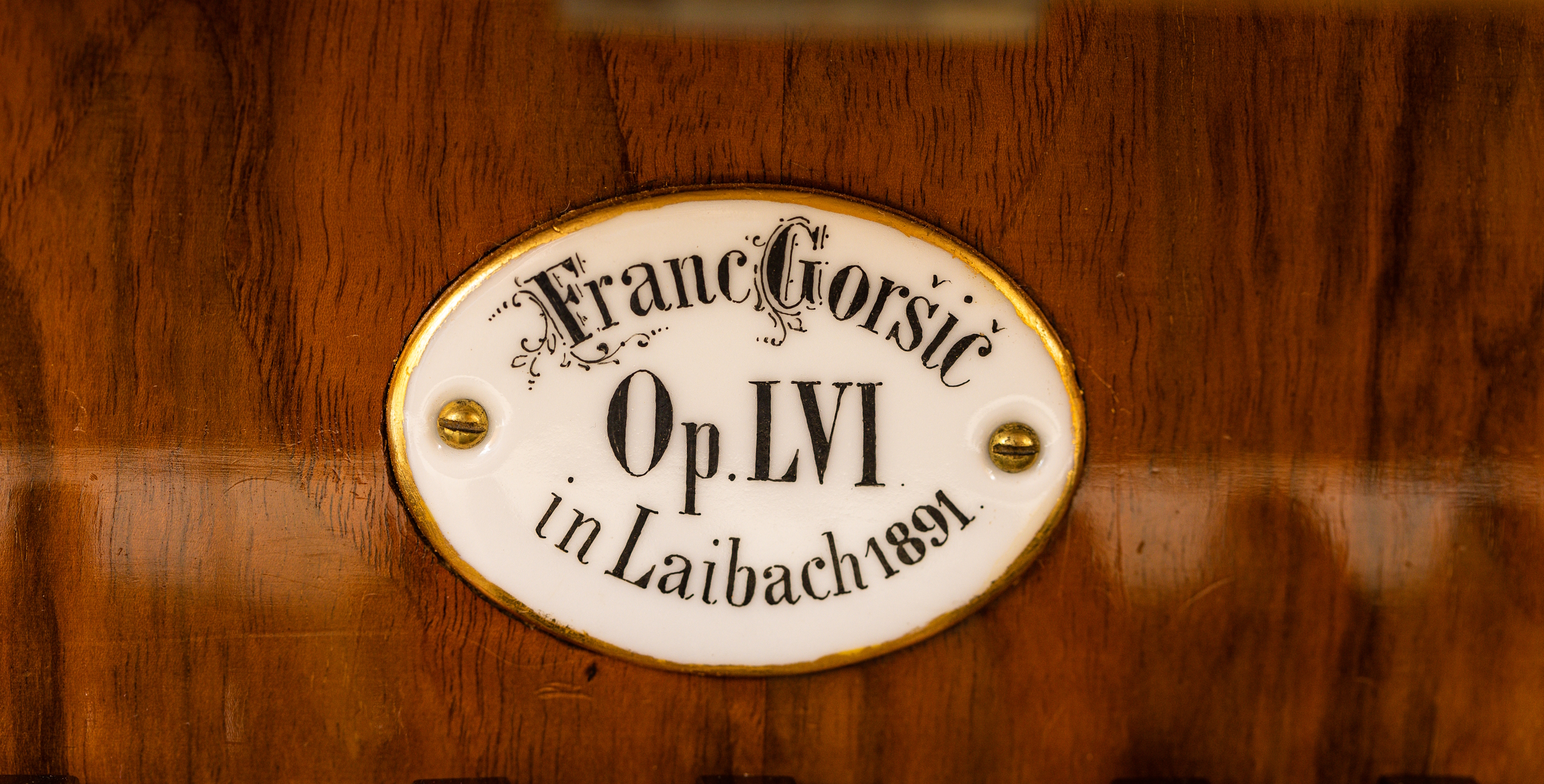
The organ in the Ursuline Church of the Holy Trinity in Ljubljana was made by Franc Goršič (1836-1898) in 1891. It has 30 singing registers (33 register pulls), three manuals and a pedal. The richly ornamented organ case, featuring a relief image of St. Cecilia, was made by Janez Vurnik Jr. (1849-1911) from Radovljica. Disposition and technical design (mechanical action tracker with cone windchest) are inspired by German Romantic organs of the mid-19th century.

Photo: Brane Košir
The organ in the Ljubljana Ursuline Church is Goršič’s only three-manual organ and the largest preserved instrument from his oeuvre. It is considered Goršič’s finest work and one of the most important historical organs in Slovenia.
The organ history
On October 1, 1890, Franc Goršič signed a contract with the authorities of the Ursuline Monastery in Ljubljana for the construction and installation of a new organ with thirty singing registers “for ceremonial free playing and the accompanying choral singing”. By that time, he had already installed three major instruments in Ljubljana: in the Trnovo church (Op. 1, 1864), in the Franciscan church at Tromostovje (Op. 11, 1870) and at St. James’s (Op. 36, 1882). In the 1880s he built several organs in Austrian Styria, e.g. in the Franciscan church in Graz (Op. 47, 1886), and became widely recognised.
Most of the work in the Ursuline Church was probably carried out by Goršič after July 1, 1891. According to a separate contract signed by him, Janez Vurnik had by then to build the organ case and prepare it for transport from Radovljica to Ljubljana.

Photo: Brane Košir
The organ sounded publicly for the first time at the mass on October 21, 1891, and it was blessed four days later. The organ was played both times by the cathedral organist Anton Foerster (1837-1926), and among the speakers at the consecration was the composer Fr. Hugolin Sattner (1851-1934). He later published a very favourable review in the publication Cerkveni glasbenik (CG 1891, No. 11, p. 84), calling Goršič’s organ “the best organ in Carniola”.
“The impression of a full organ is mighty, always dignified, suitable for the church, never trivial …”
Fr. Hugolin Sattner in his review of Goršič Organ, 1891
The first major documented intervention on the organ dates back to 1935. At that time, the Ljubljana organ builder Franc Jenko (1896-1968), while replacing the electrical wiring on the choir, installed an electric motor in the organ to supply air to the main bellows (with a blower and regulator of his own production) and added the necessary air duct. A few years later (around 1937), when the organ was converted to three-phase alternating current, it was replaced by a high-quality electric motor with its own blower and a single housing made by the Swiss Meidinger factory. This motor still serves as the main organ air supply motor. In 1976, the organ was repaired by Anton Jenko (1931-2009) “due to dryness and sticking of registers” and a smaller Laukhuff electric motor was installed inside the organ case. He used a higher wind pressure to improve the operation of the bellows and reservoirs. He closed the duct from the storage bellows and made a new air inlet directly from the Meidinger blower. He cleaned the pipes and performed minor voicing adjustments.

Photo: Historical Archives Ljubljana
Organ restoration 2013-2014
In 2013 and 2014, the Goršič organ in the Ursuline Church in Ljubljana was comprehensively and systematically restored by organ builder Brane Košir (born 1958) in collaboration with the Restoration Centre of the Institute for the Protection of Cultural Heritage of the Republic of Slovenia. Previously, the dry air in the church had caused new damage (cracks) to the windchest, wind supply and wooden pipes. The two windchests for II. The manual were dismantled in order to thoroughly repair the cracks, while the others were restored on-site. He restored the console, repaired and realigned all trackers. The air inlet from the blower to the storage bellows was redesigned and refined. After rebuilding the windchests, bellows, and ducts, he removed the added Laukhuff electric blower from the organ case. Košir cleaned and restored all the metal and wooden pipes, paying particular attention to preserving Goršič’s original intonation and register tuning. The organ was completely restored to its original condition, with only the bellows for the connections and reservoirs utilizing a higher wind pressure (as Anton Jenko had done before) for more reliable operation.
“The organ case has been restored, and the exterior is now in harmony with the sounds of this complex instrument. A thick layer of dust and soot was removed, and cracks and damages in the wood were filled in, carefully retouched and also reconstructed. We have refreshed and replaced the worn gilding. The original painting – an imitation of wood in the technique of life – once again glowed in warm tones.”
Nuša Saje and Nuška Dolenc Kambič, conservator-restorers
Taken from the text by Tomaž Sevšek Šramel


