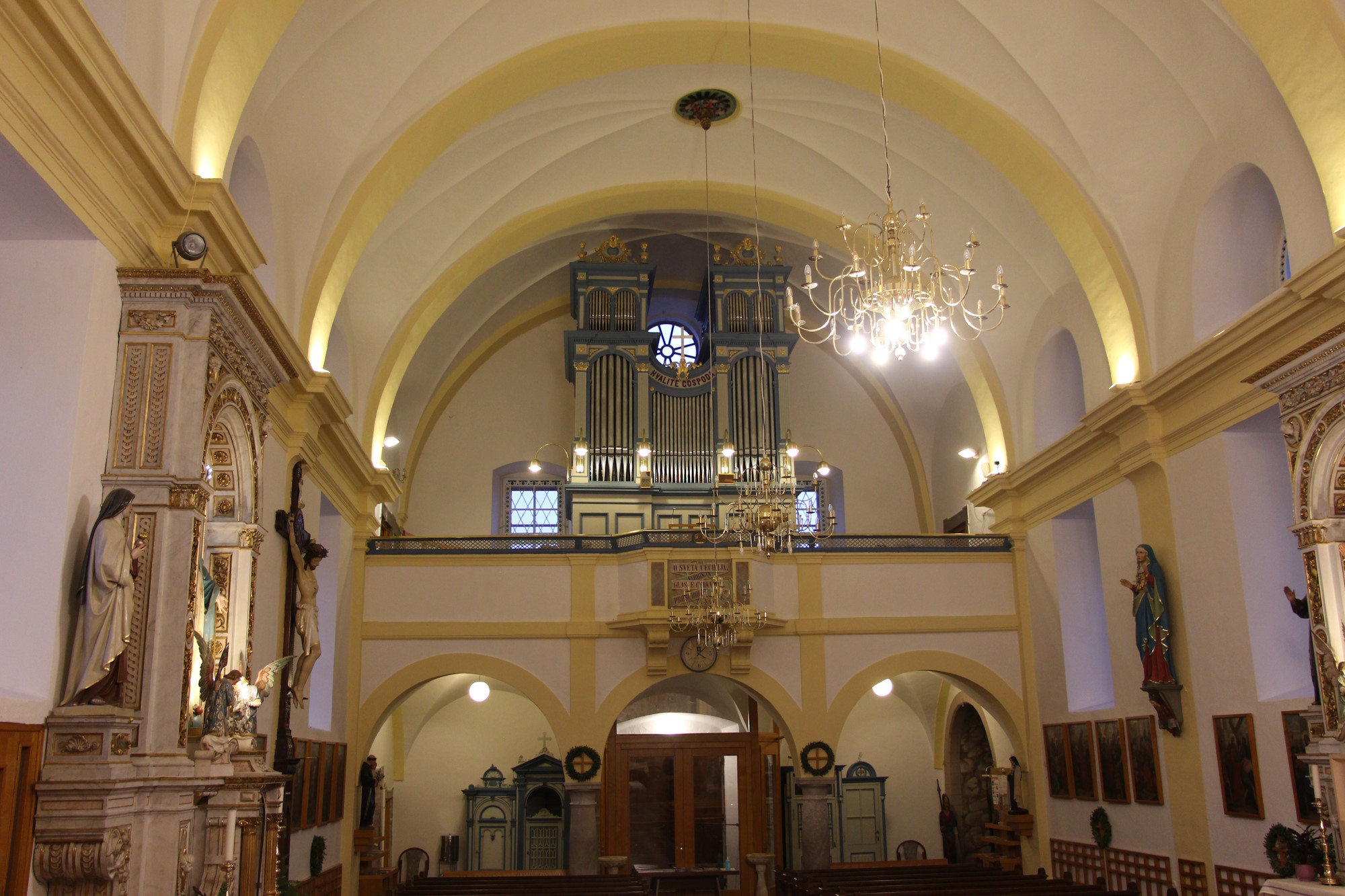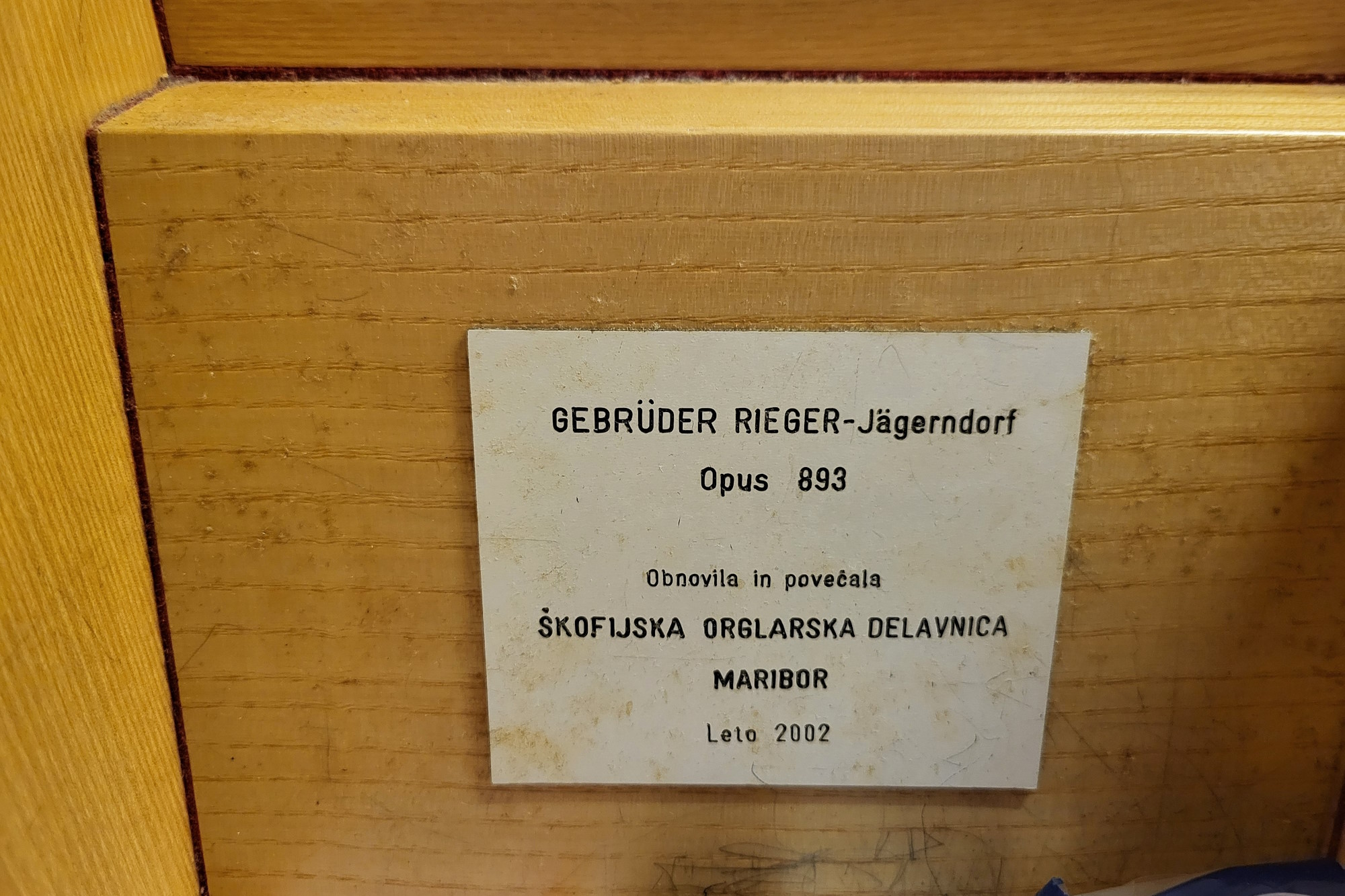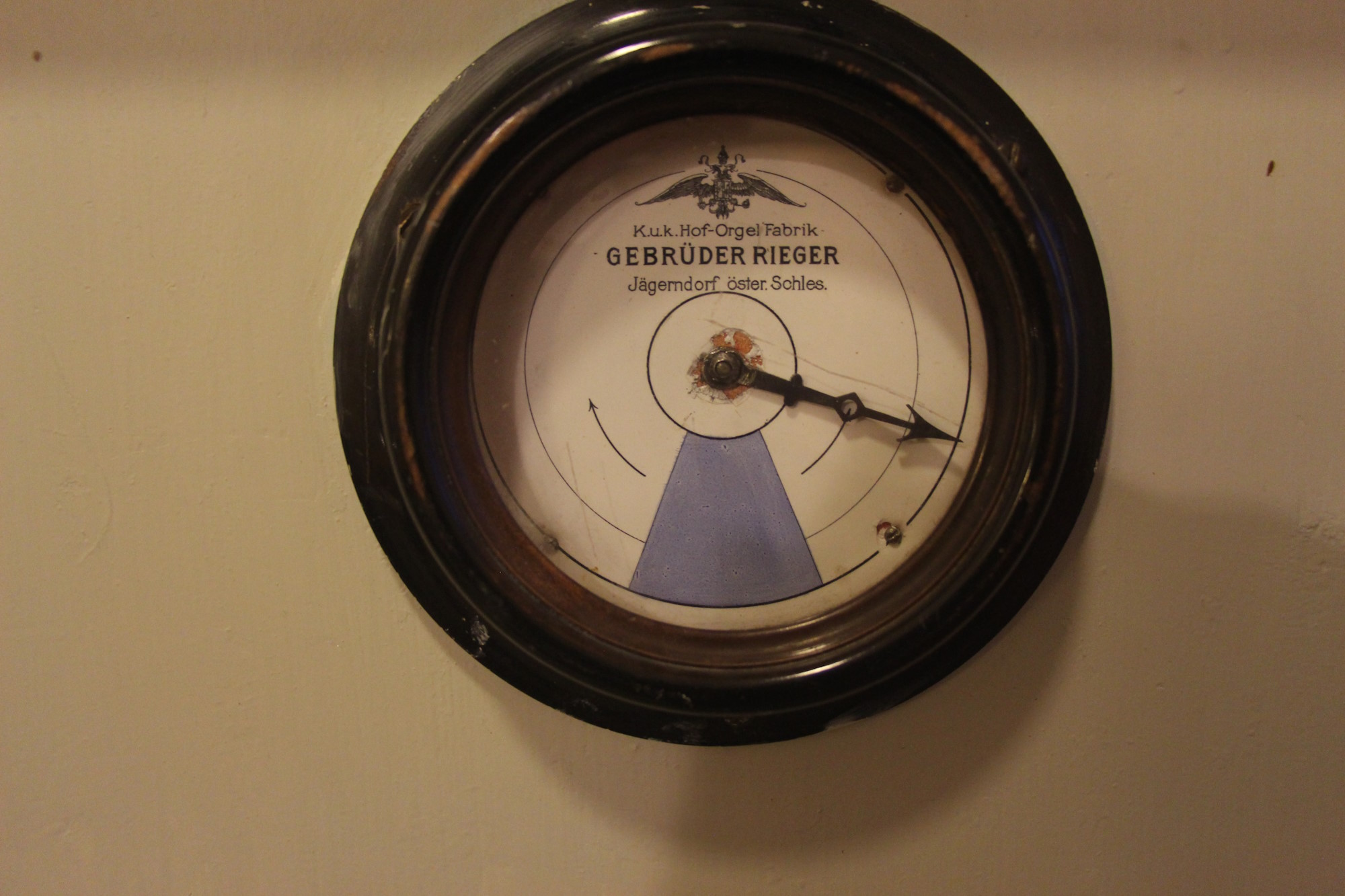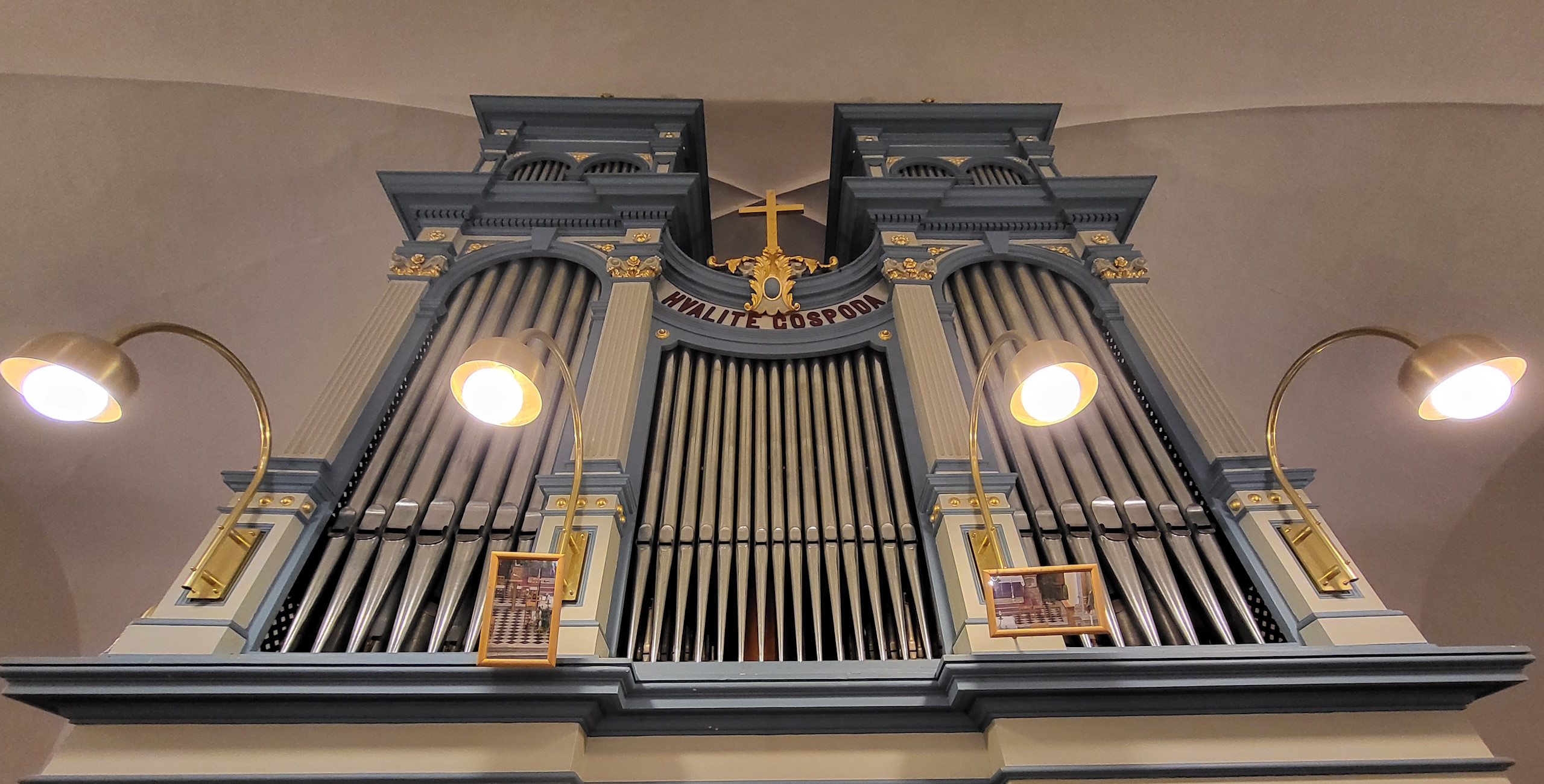
In 1902, on the occasion of the 50th anniversary of the Lazarists’ arrival in Celje, the Rieger brothers’ firm (Gebrüder Rieger, K.u.K. Hof-Orgel-Fabrik) from Jägerndorf (today Krnov, Czech Republic) built a new pipe organ for the parish Church of St. Joseph in Celje as their Opus 893. The instrument had 20 registers distributed across two manuals and a pedal, as well as pneumatic action, which was considered an advanced technical feature in the late Romantic period. The console was positioned in front of the organ. According to old sources, the organ had a full, mellow sound, well suited to accompanying the choir and folk singing.
Original disposition of the Rieger organ from Jägerndorf, 1902
| I. Manual | II. Manual | Pedal (C – d1) |
| Burdon 16’ | Geigenprincipal 8’ | Violon 16’ |
| Principal 8’ | Rohrflöte 8’ | Subbas 16’ |
| Hohlflöte 8’ | Aeoline 8’ | Oktavbas 8’ |
| Gamba 8’ | Vox coelestis 8’ | Cello 8’ |
| Salicional 8’ | Octave 4’ | |
| Gedeckt 8’ | Flöte 4’ | |
| Oktave 4’ | ||
| Flöte 4’ | ||
| Cornett II – III 2 2/3′ | ||
| Mixtur VI 2 2/3′ |
The shortcomings of the pneumatic system soon became apparent, as it was sensitive to climatic conditions, particularly during the winter months. In 1926, the priest and composer Alojzij Mav drew attention to these problems in the journal Cerkveni glasbenik, writing: “This unfortunate Rieger – why did they have to experiment on us first!” (A. Mav, Sv. Jožef nad Celjem, in Cerkveni glasbenik 49 (1926), p. 47). These technical shortcomings also affected how the organ was perceived by musicians.
Restoration and enlargement of the organ
Towards the end of the 20th century, the question of enlarging and restoring the organ arose. A key role was played by the parish priest at the time Jože Planinšek, who, together with the Maribor Diocesan Organ Workshop, concluded that although the organ was not a technical masterpiece of its time, its powerful yet mellow sound filled the church exceptionally well and made it well suited to accompanying both the choir and folk singing. Rev. Planinšek also pointed out the financial and cultural implications of replacing the organ entirely, noting that, as artistic tastes change, its Romantic disposition might once again prove relevant.
Although pneumatic organs are often overlooked today, it became clear that the organ at St. Joseph’s was entirely suitable for restoration and that it had remained remarkably well preserved after more than a century. The prevailing view was therefore that the organ deserved a thorough restoration and enhancement rather than replacement. Following extensive consultations, in 2002 the parish of Celje – St. Joseph decided to restore and enlarge the Rieger organ, with the work carried out by the Maribor Diocesan Organ Workshop.
The greatest technical challenge of the restoration was posed by the windchests, while the wooden parts of the organ – including the pipes and the case – remained in excellent condition. Long-term observation showed that the problems were not insurmountable: organs that are regularly played remain flexible, while organs that remain silent deteriorate. More stable climatic conditions, ensured by the church’s new heating system, significantly reduced the risks to the pneumatic components.
Prof. Mario Perestegi prepared two proposals for enlarging the disposition: adding new registers to the existing manuals or installing a new third manual. Due to spatial constraints, the second proposal was selected.
The disposition was expanded by eight new registers, mounted on pneumatic windchests based on the original design. The pedal division was strengthened with two 16’ registers, while the organ gained two new reeds: a 16’ Trombone in the pedal and an 8’ Oboe on the second manual.
The restored organ now has 1,554 pipes, of which 1,020 are original Rieger pipes and 534 are new. The instrument was also fitted with electropneumatic action and two electric consoles.
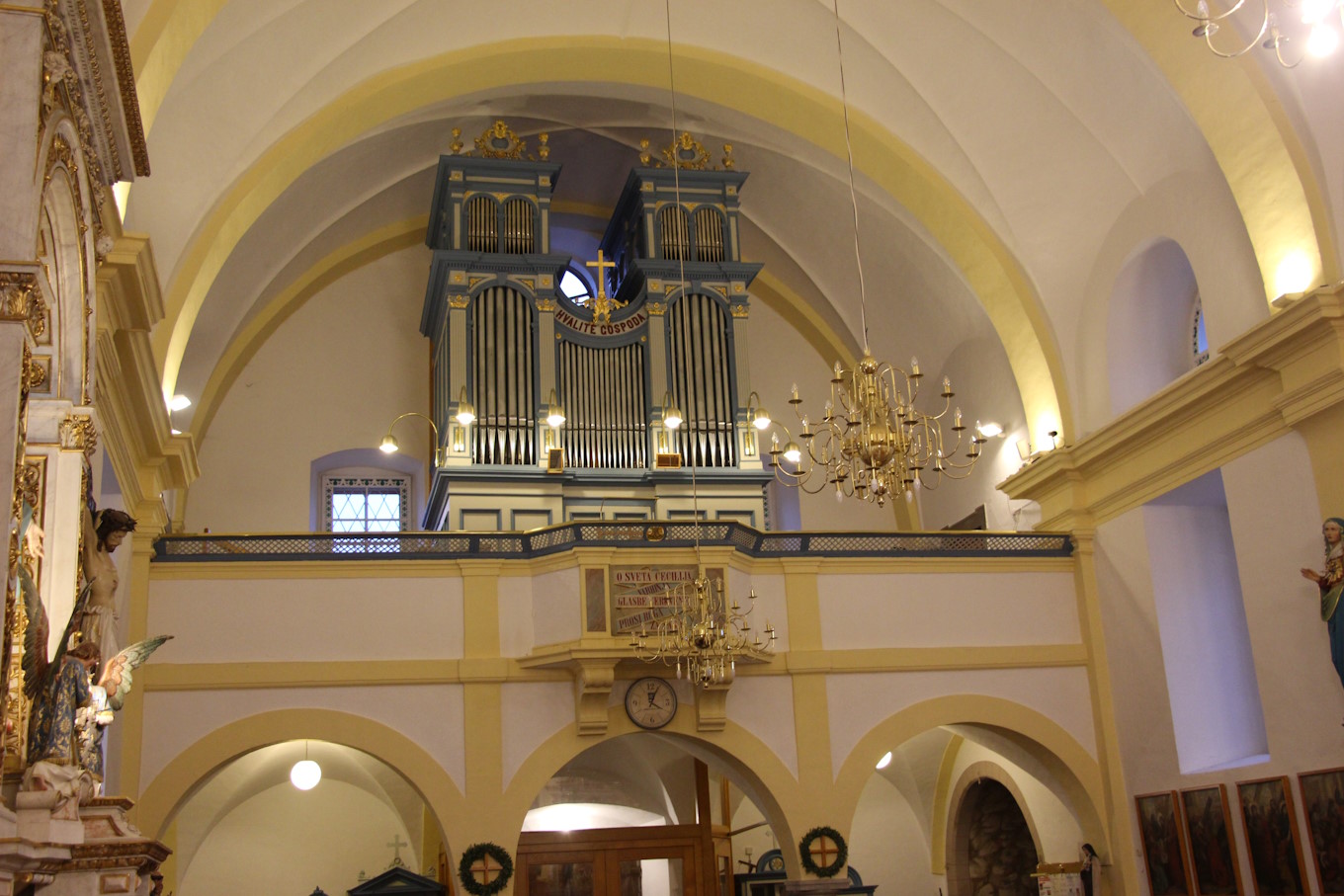
Photo: Organistica
Organ disposition with the arrangement of the new registers
*The newly added registers are shown in bold.
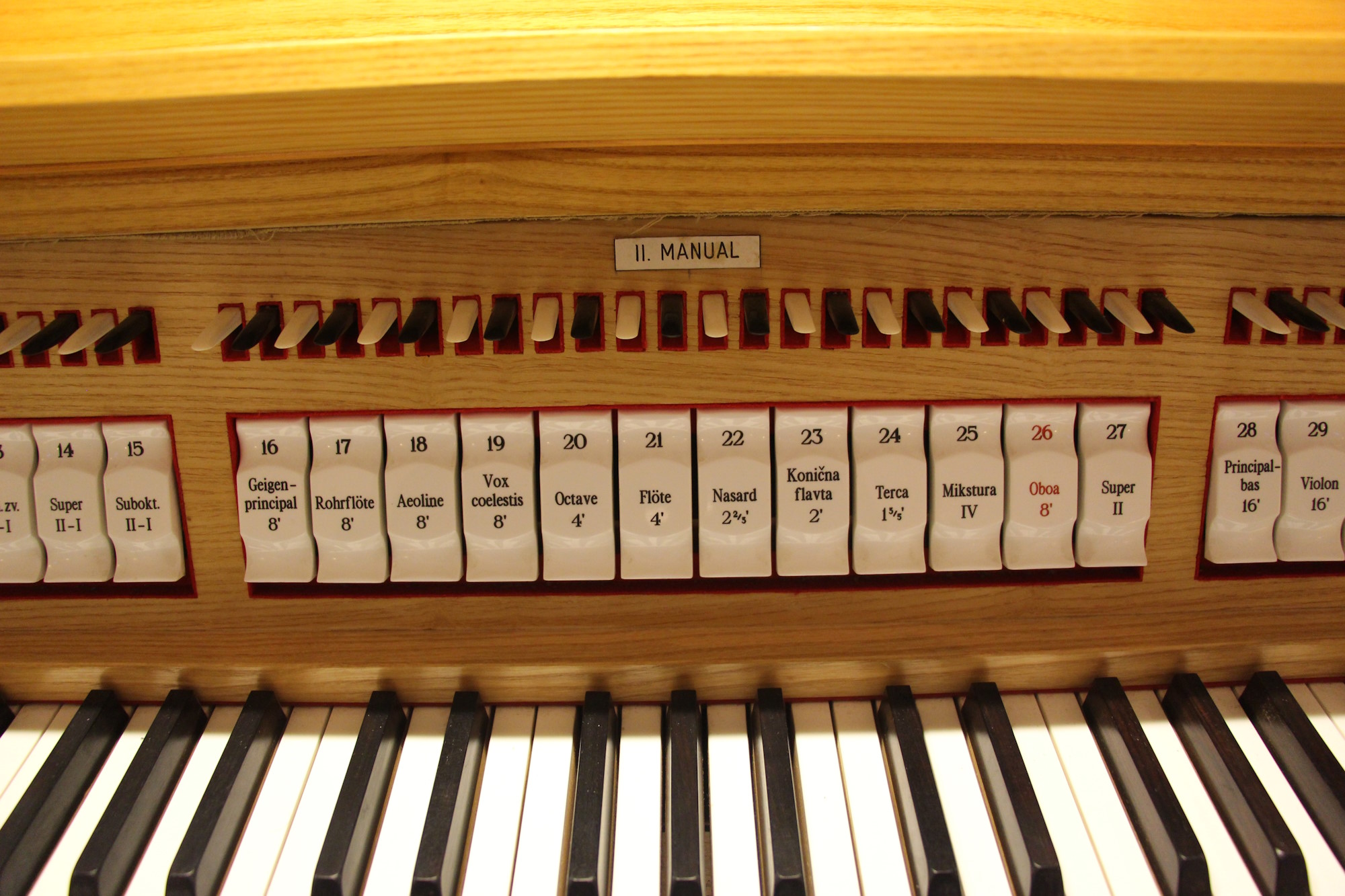
| I. Manual (C – g3) | II. Manual (C – g3) | Pedal (C – f1) |
| Burdon 16’ | Geigenprincipal 8’ | Principalbas 16’ |
| Principal 8’ | Rohrflöte 8’ | Violon 16’ |
| Hohlflöte 8’ | Aeoline 8’ | Subbas 16’ |
| Gamba 8’ | Vox coelestis 8’ | Oktavbas 8’ |
| Salicional 8’ | Octave 4’ | Cello 8’ |
| Gedeckt 8’ | Flöte 4’ | Pozavna 16′ |
| Oktave 4’ | Nasard 2 2/3′ | |
| Flöte 4’ | Konična flavta 2′ | |
| Cornett II – III 2 2/3′ | Terca 1 3/5′ | |
| Superoktava 2′ | Mikstura IV 1 1/3′ | |
| Mixtur VI 2 2/3′ | Oboa 8′ |
The result is clear, functional and respectful of the organ’s historical heritage. The restored organ is also opus 66 of the Maribor Diocesan Organ Workshop. Eng. Brane Košir emphasized the project’s guiding principle: respect for the past and an awareness that art moves in cycles. This approach also included preserving the original console as a display object and as part of the organ’s cultural heritage.
On the occasion of the 150th anniversary of the Lazarists’ arrival in Celje, the church thus once again gained a reliable organ, now offering a much richer palette of tonal colours and making it possible to perform more demanding and technically more virtuosic repertoire.
What condition is the organ in today and what work is required?
In 2025, 23 years after the restoration and enlargement of the organ, the parish of Celje – St. Joseph decided to have the instrument serviced. They approached Organistica for assistance in preparing a professional assessment of the organ’s condition and recommendations for the necessary work.
A detailed inspection of the organ was carried out on 6 December 2025. During the inspection, the organ was partially documented and the extent of the damage that had occurred was assessed. Based on the data collected and processed, we prepared a detailed report.
Organ disposition >
Description of pipe registers >
Wind system
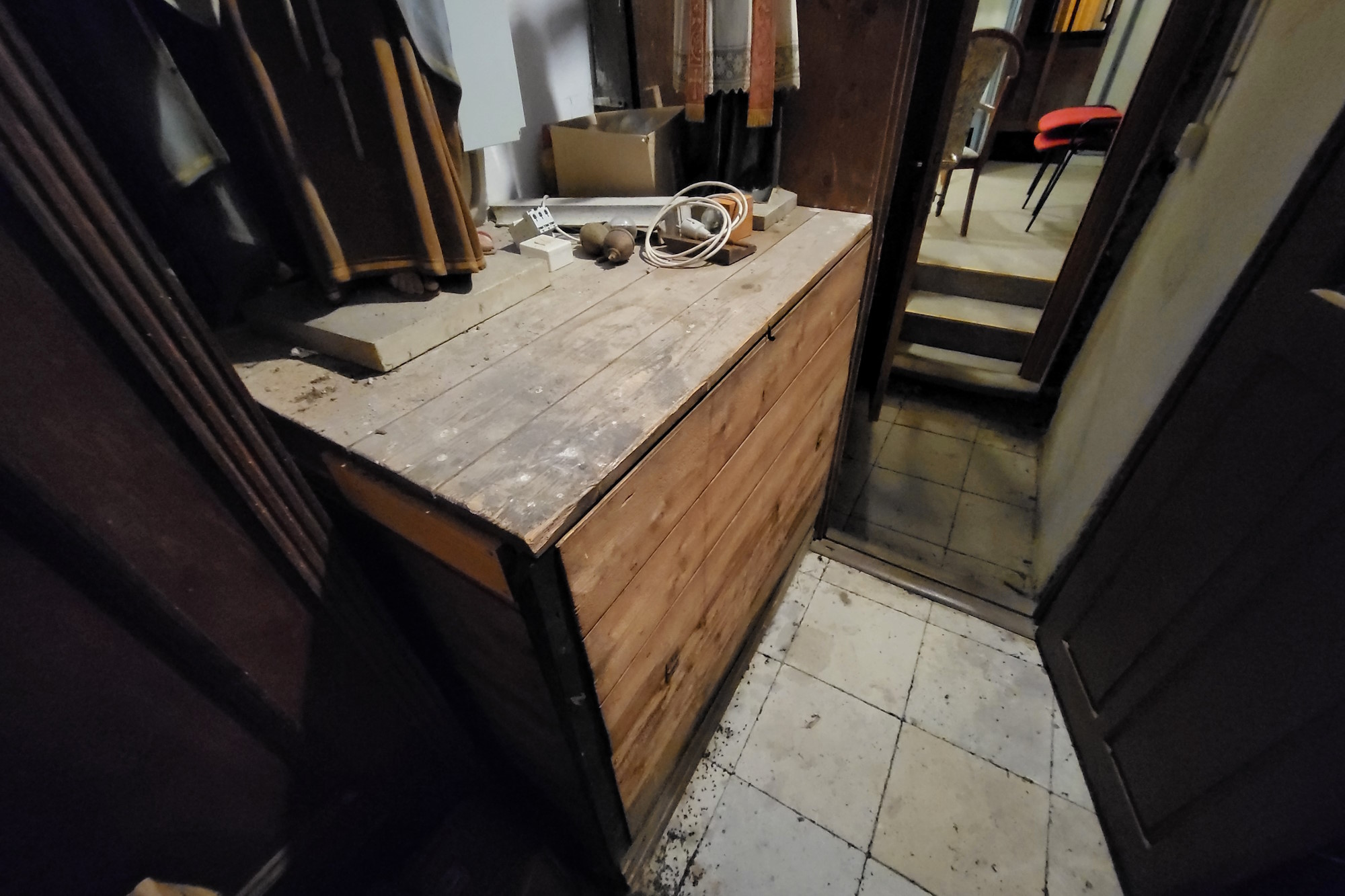
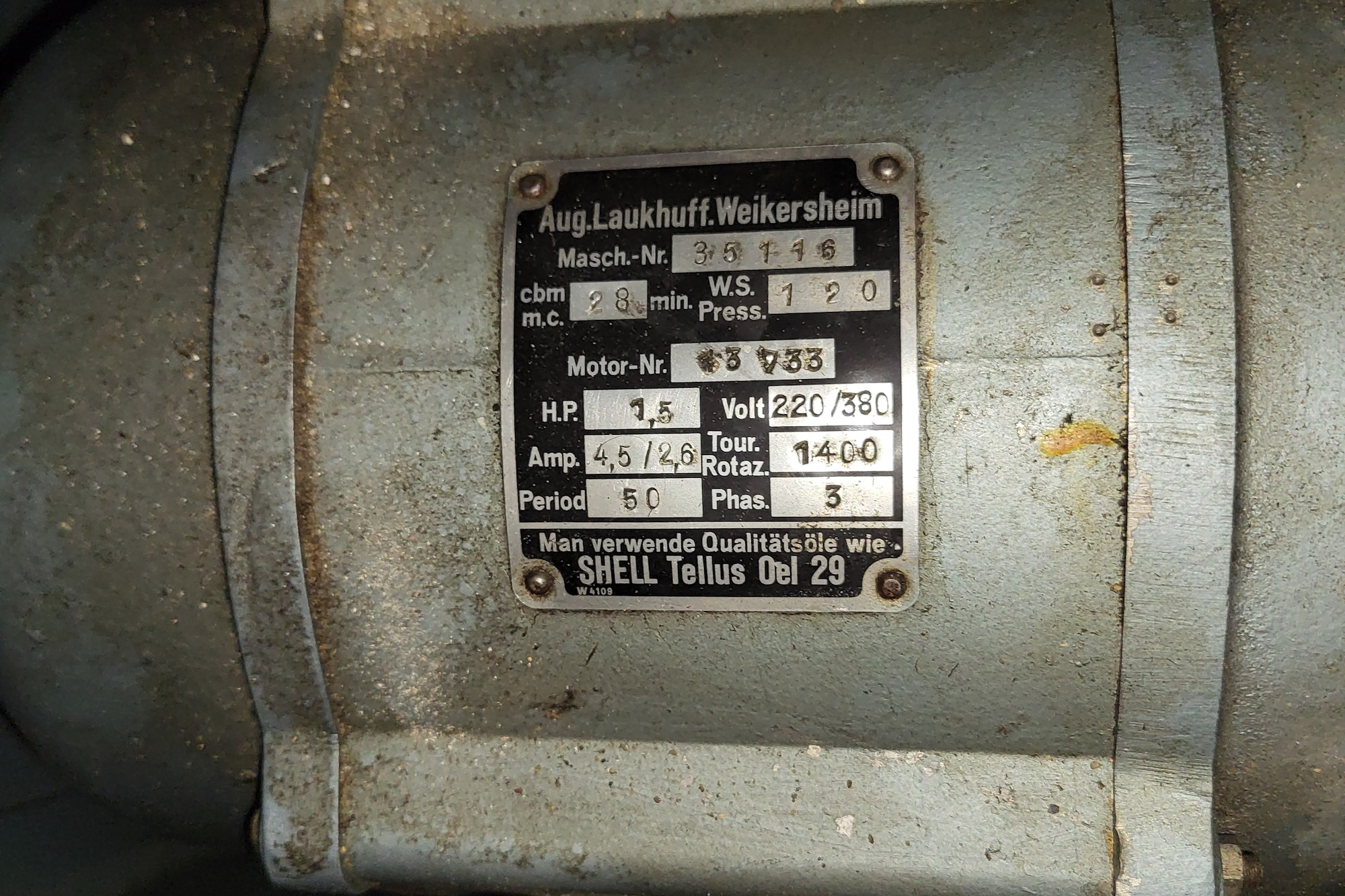
The main double bellows, measuring 3,000 × 1,580 mm, are supplied by an Aug. Laukhuff – Weikersheim electric blower, No. 35116, with a capacity of 28 m³/min, a pressure of 120 mm WS, 1.5 HP and a speed of 1,400 rpm. The blower is installed in the church’s northern bell tower. From the main bellows, air is supplied through four wind channels to the windchests, i.e. the register chests, of the manual and pedal divisions. The air pressure in the main bellows is 97 mm.
As part of a general restoration of the organ, it would be advisable to construct a new solid wooden protective enclosure with additional internal acoustic insulation. The enclosure’s air intake should be fitted with an appropriate air filtration system, as the blower draws air from inside the church.
The main bellows should be opened, cleaned and resealed as necessary. Depending on its condition, worn leather should be partially or completely replaced, particularly at the folds and on the inside. Similarly, the blue paper covering on the visible outer surfaces of the reservoir should be replaced.
The wind channels supplying air to the windchests should be cleaned and inspected and, where necessary, additionally sealed or replaced/reconstructed.
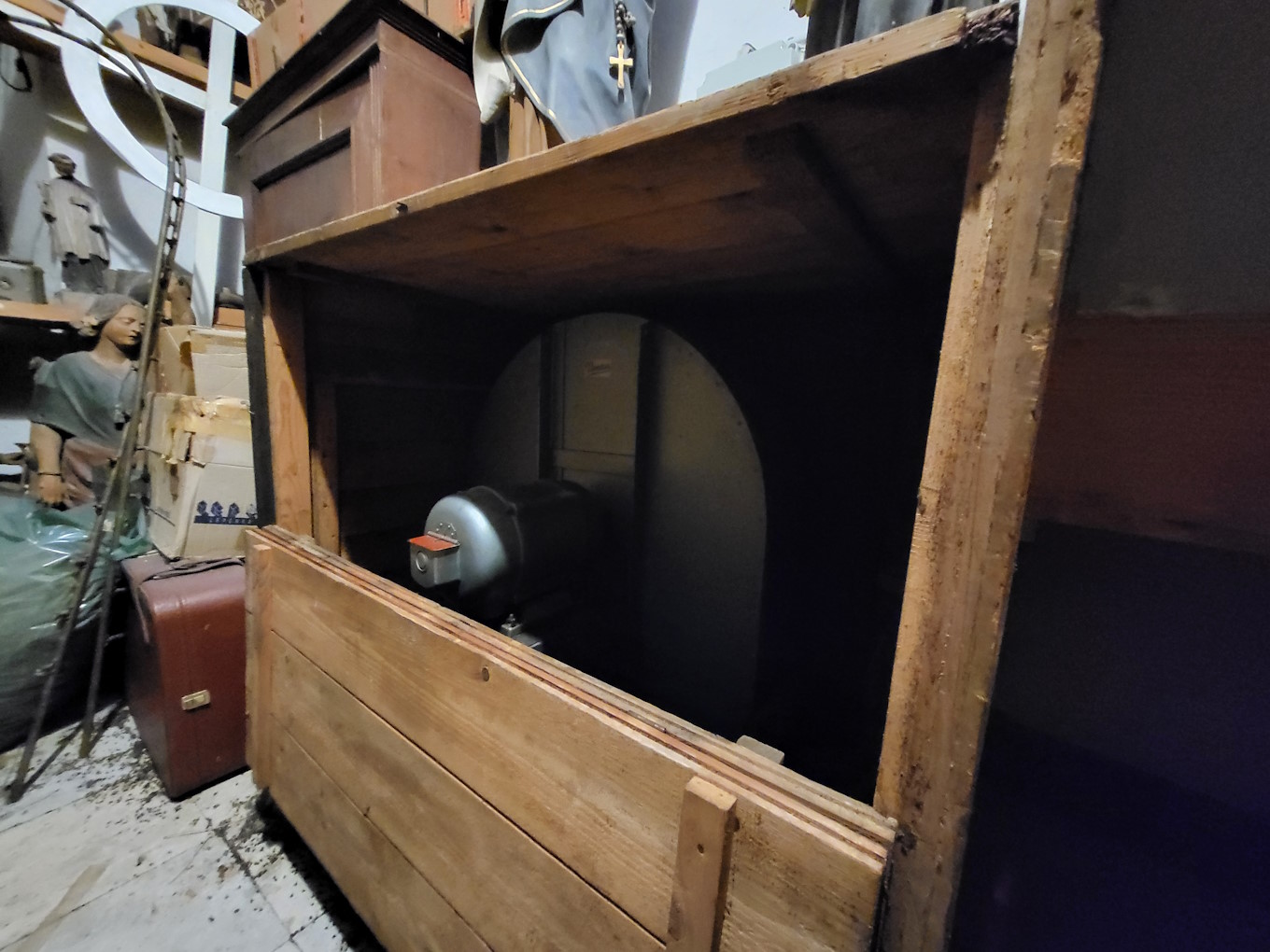
Photo: Organistica
Pneumatics
In the event of a general restoration of the organ, the condition of the membranes should be inspected. The pneumatic system in the windchests should be thoroughly adjusted and regulated. When ordering suitable replacement membranes, particular attention should be paid to the choice of material and the quality of their manufacture. The quantity to be ordered should also be agreed upon between the contractor and the client, including the possibility of keeping a supply of materials for future maintenance.
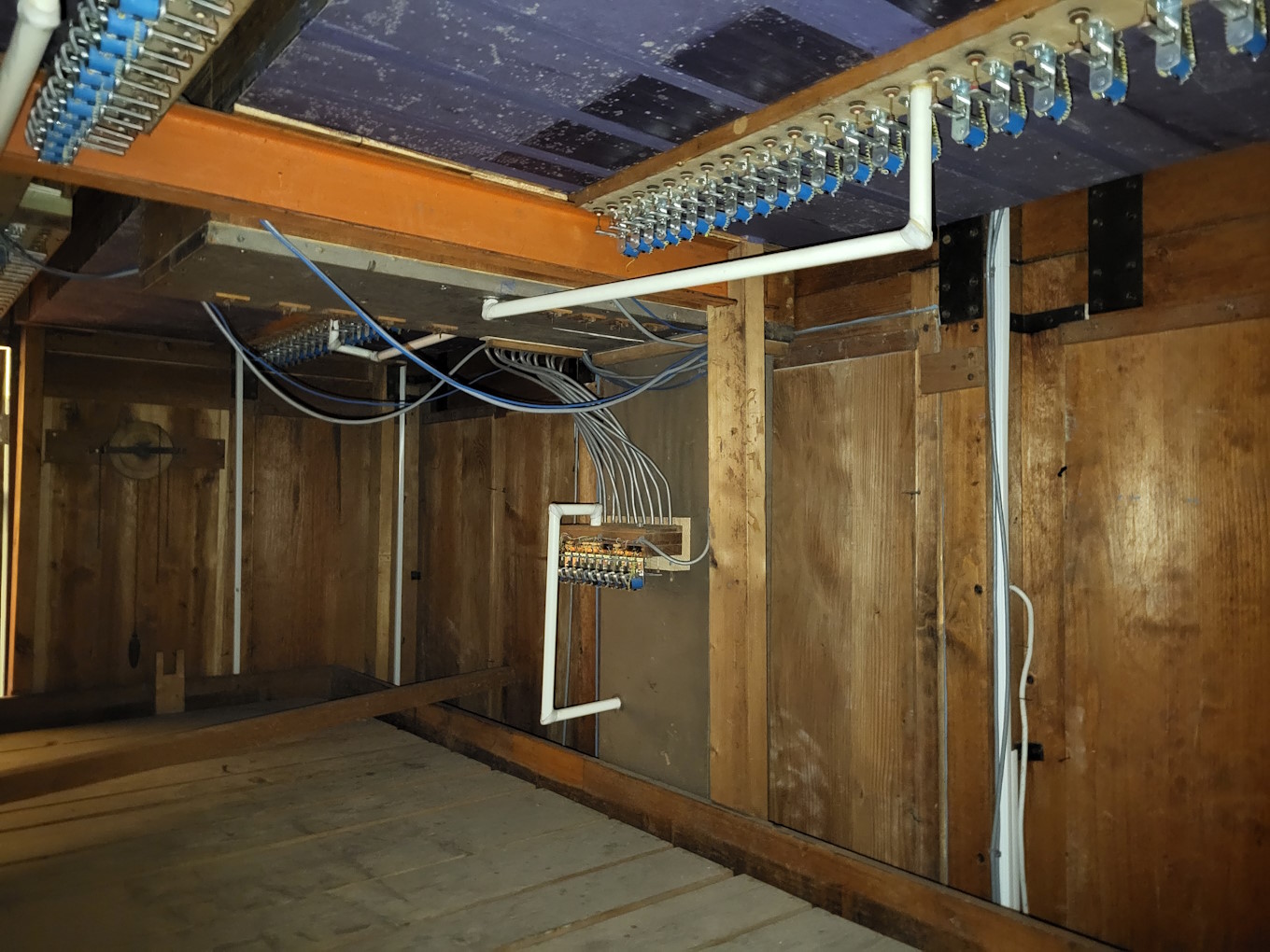
Photo: Organistica
Windchests
In parallel with the adjustment of the pneumatic system, the condition and operation of the windchests should also be inspected. It would be advisable to consult with a specialist about the possibility of modifying the new pedal windchest for the Principalbass 16′ and Pozavna 16′ so that it is properly suited to the registers installed on it. The Principalbass 16′ register has an undersized air supply and consequently, even when its air inlet is fully open, it fails to produce a full, powerful tone. In addition, the pipes are positioned too closely together, which further contributes to the problem. The Pozavna 16′ register, meanwhile, is completely inaccessible for tuning.
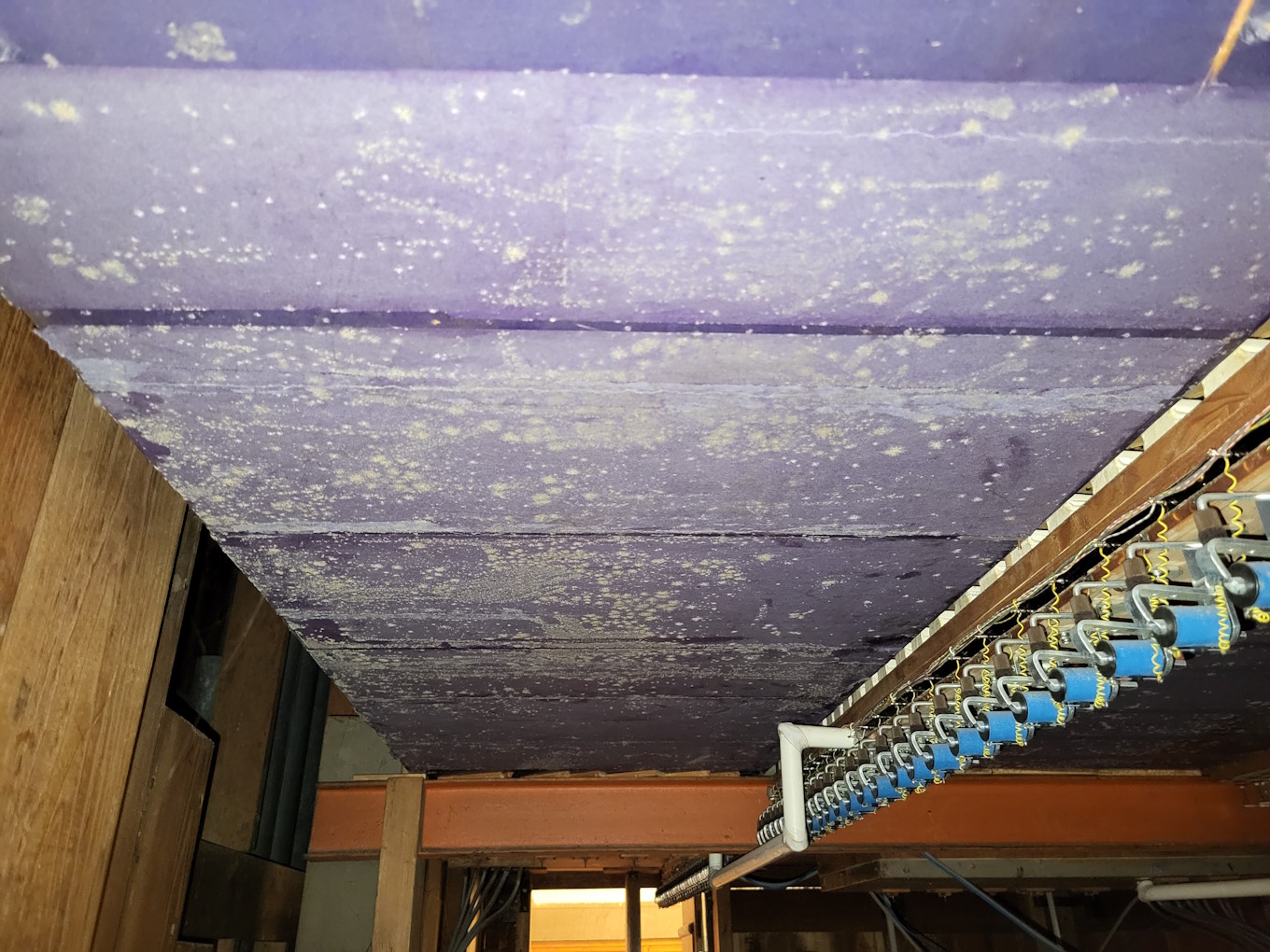
Photo: Organistica
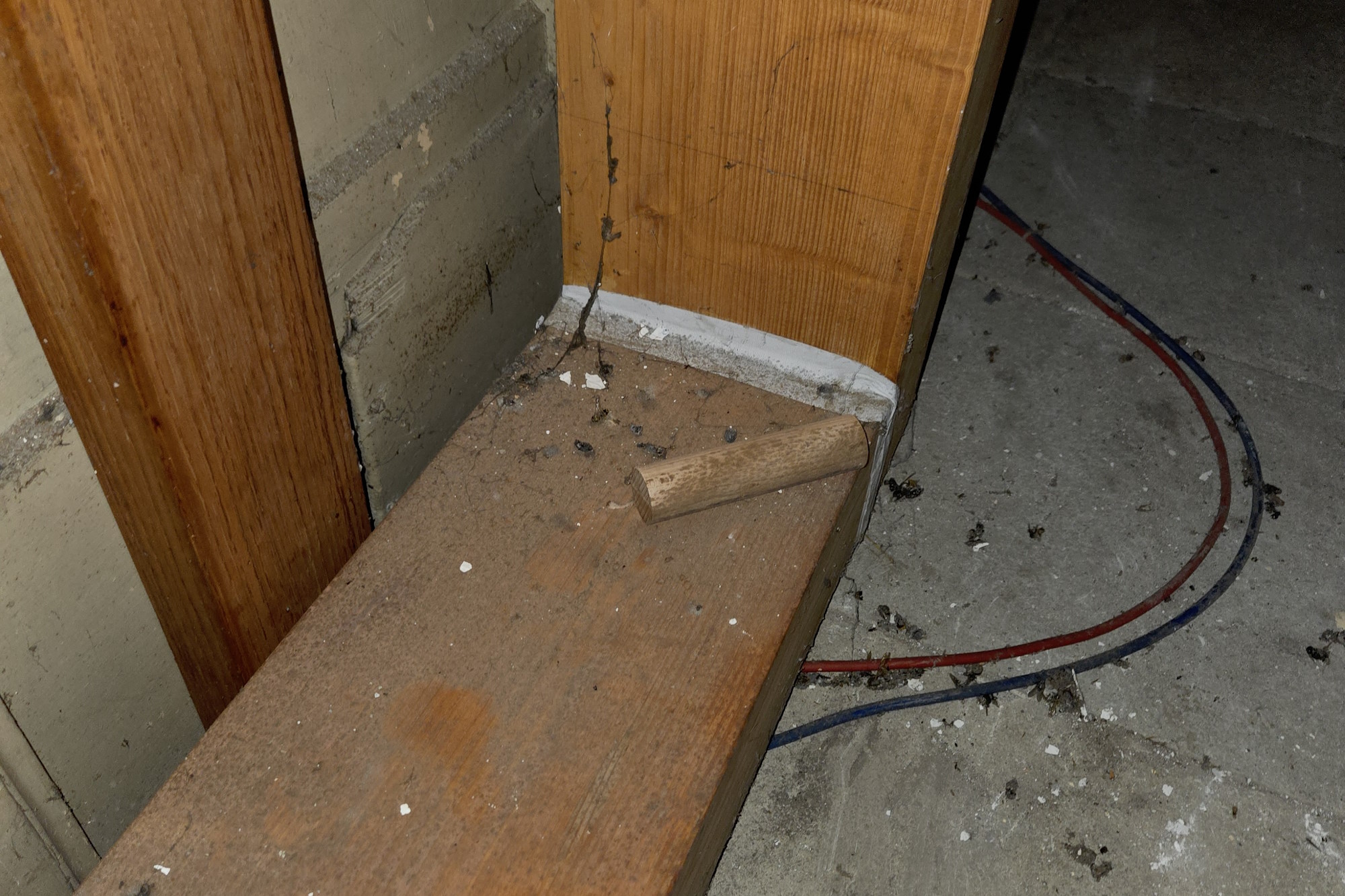
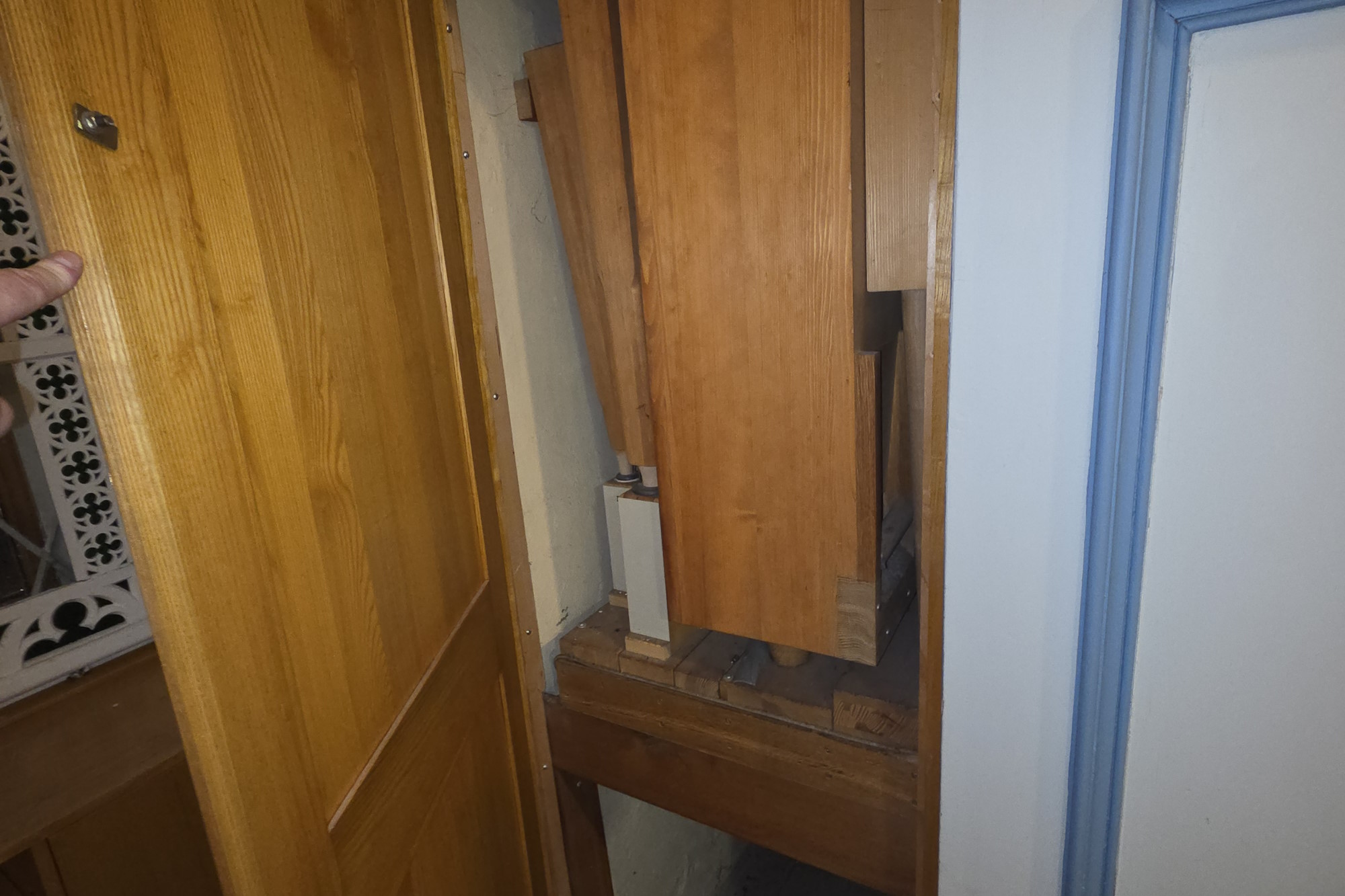
Access to the added pipes in the upper part of the organ case should be improved, particularly for tuning the 8′ Oboa reed. Access should be easy and safe. A significant improvement would be to install an additional wooden platform on the ceiling between the organ cases and to securely fasten the existing platform inside the case.
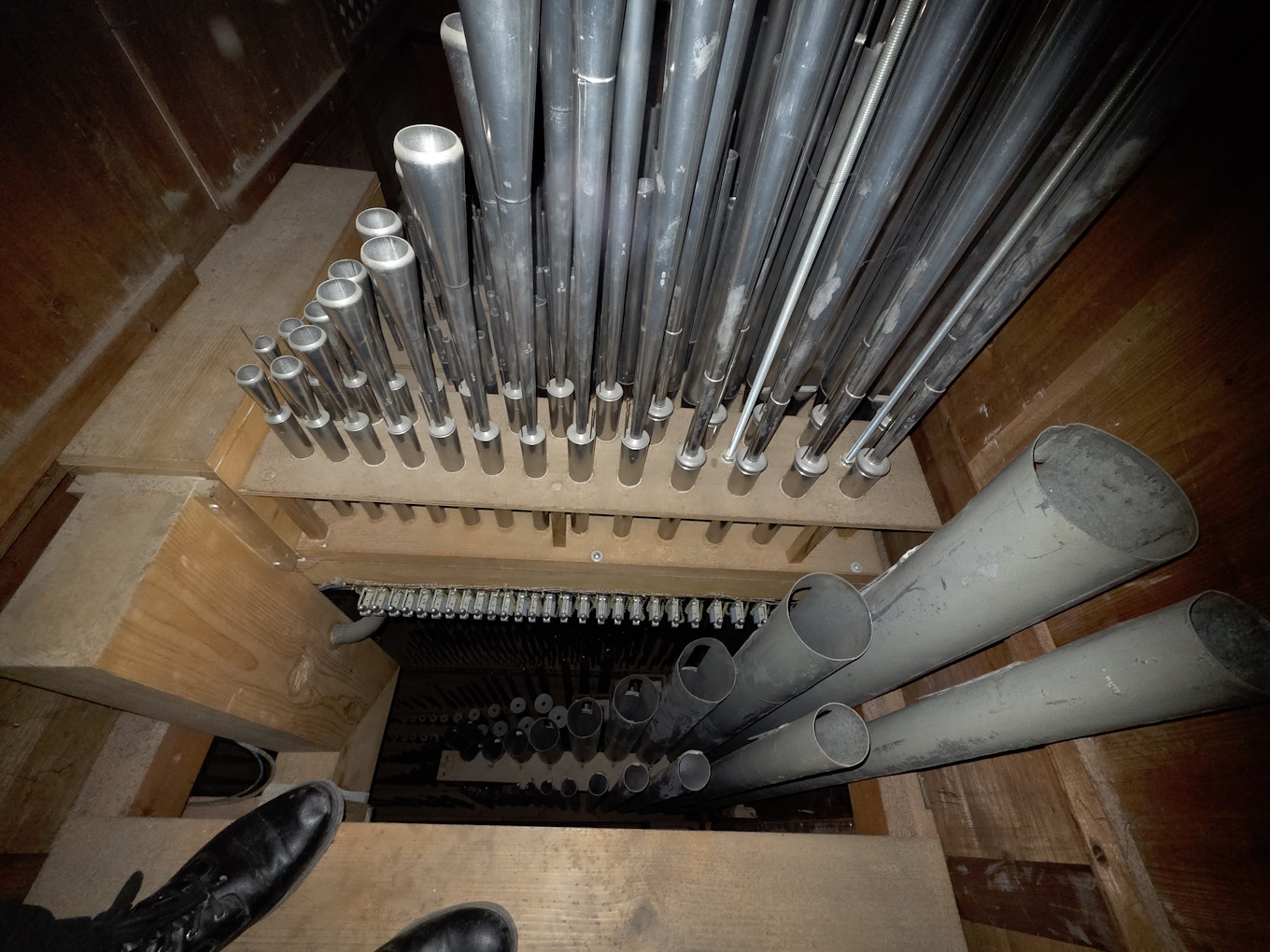
Photo: Organistica
Arrangement of the pipes on the windchests (from the altar/front towards the rear wall)
*The windchests of the Manual I and Manual II are positioned at the same level, i.e. on the first level above the organ’s wind system.
| I. Manual (1. level) Principal 8′ Gamba 8′ Hohlflöte 8′ Burdon 16′ Salicional 8′ Cornett II-III 2 2/3′ Mixtur VI 2 2/3′
II. Manual (1. level) Vox coelestis 8′ Rohrflöte 8′ Geigenprincipal 8′ Aeoline 8′
New registers on the new windchest (2. level) Superoktava 2′ Mixtura III-IV 1 1/3′ Terca 1 3/5′ Konična flavta 2′ Nasard 2 2/3′ Oboa 8′
Pedal (floor level, lower rear section of the organ case) Subbas 16′ Violon 16′
New registers on the new windchest (behind the organ case) Principalbas 16′ Pozavna 16′ |
Pipes
After dismantling, all pipes should be cleaned and restored using established conservation and restoration procedures.
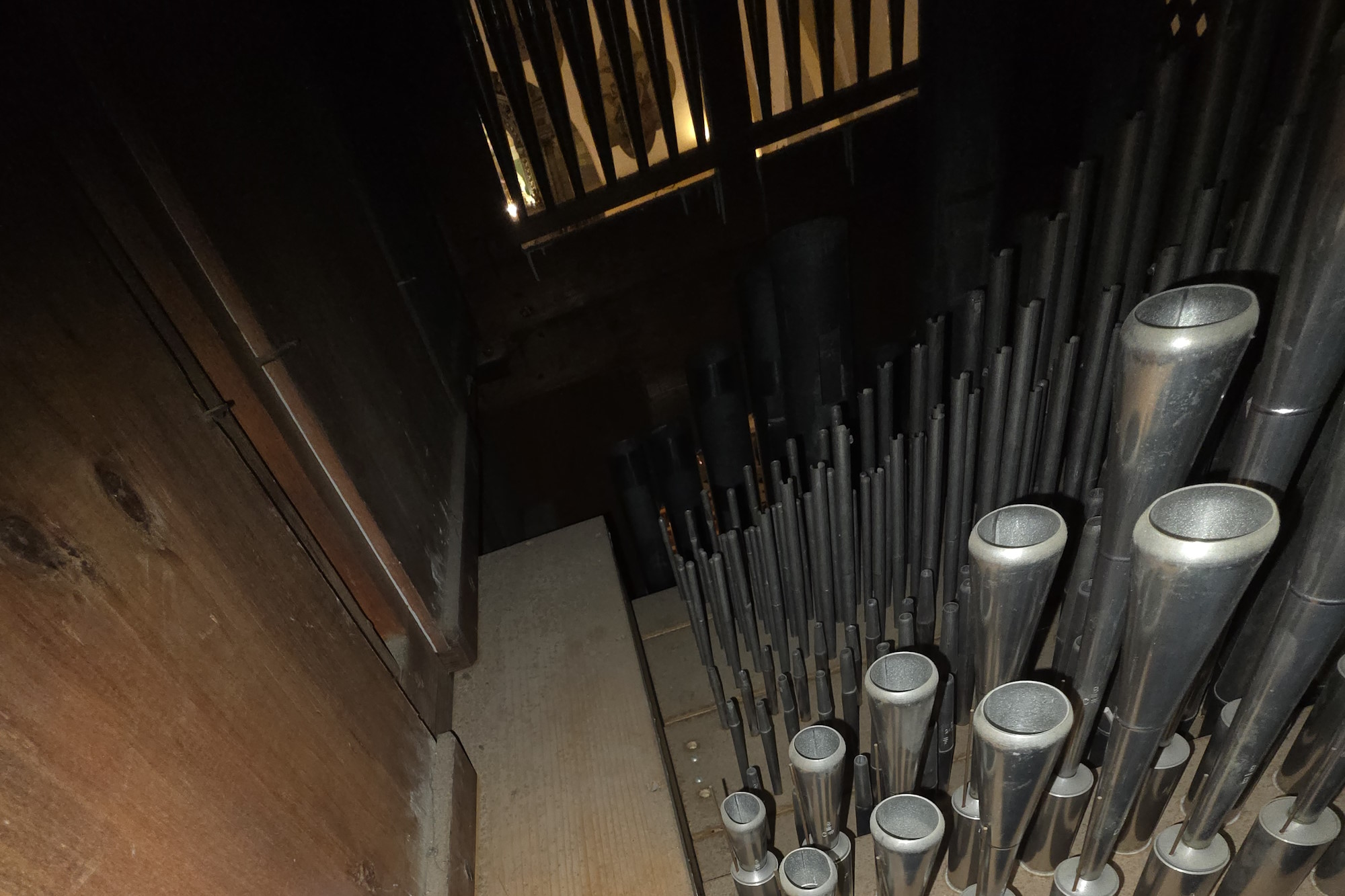
The metal pipes should be straightened, and their feet, which have become deformed under their own weight, will be repaired and reinforced. The edges of the regulating slots damaged during tuning will be repaired by soldering. Some metal pipes were improperly replaced during previous interventions, using pipes of incorrect dimensions. These include replacements with pipes without regulating slots, conical pipes replaced with cylindrical pipes, and pipes with feet of incorrect height. Such pipes should be replaced with appropriate replicas.
The façade pipes will, according to the agreed procedure, be manually or mechanically polished during the restoration to restore their original lustre.
All cracks and failed glued joints in the wooden pipes should be repaired. Any damage caused by wood-boring insects should likewise be treated, and the pipes should be adequately protected against further infestation. All stoppers should be removed and the gaps properly adjusted. Rusted screws should be polished, while damaged screws should be replaced. On stopped pipes, the caps should be restored and adjusted, and hardened leather should be replaced, with the sealing modified using felt. All handles on the caps that are damaged or have lost the necessary strength due to woodworm damage should be replaced with new ones made as replicas. Likewise, deteriorated woodworm-damaged pipe feet should be replaced with replicas.
Particular attention should be paid to achieving an appropriate balance of the tonal colours of the reeds.
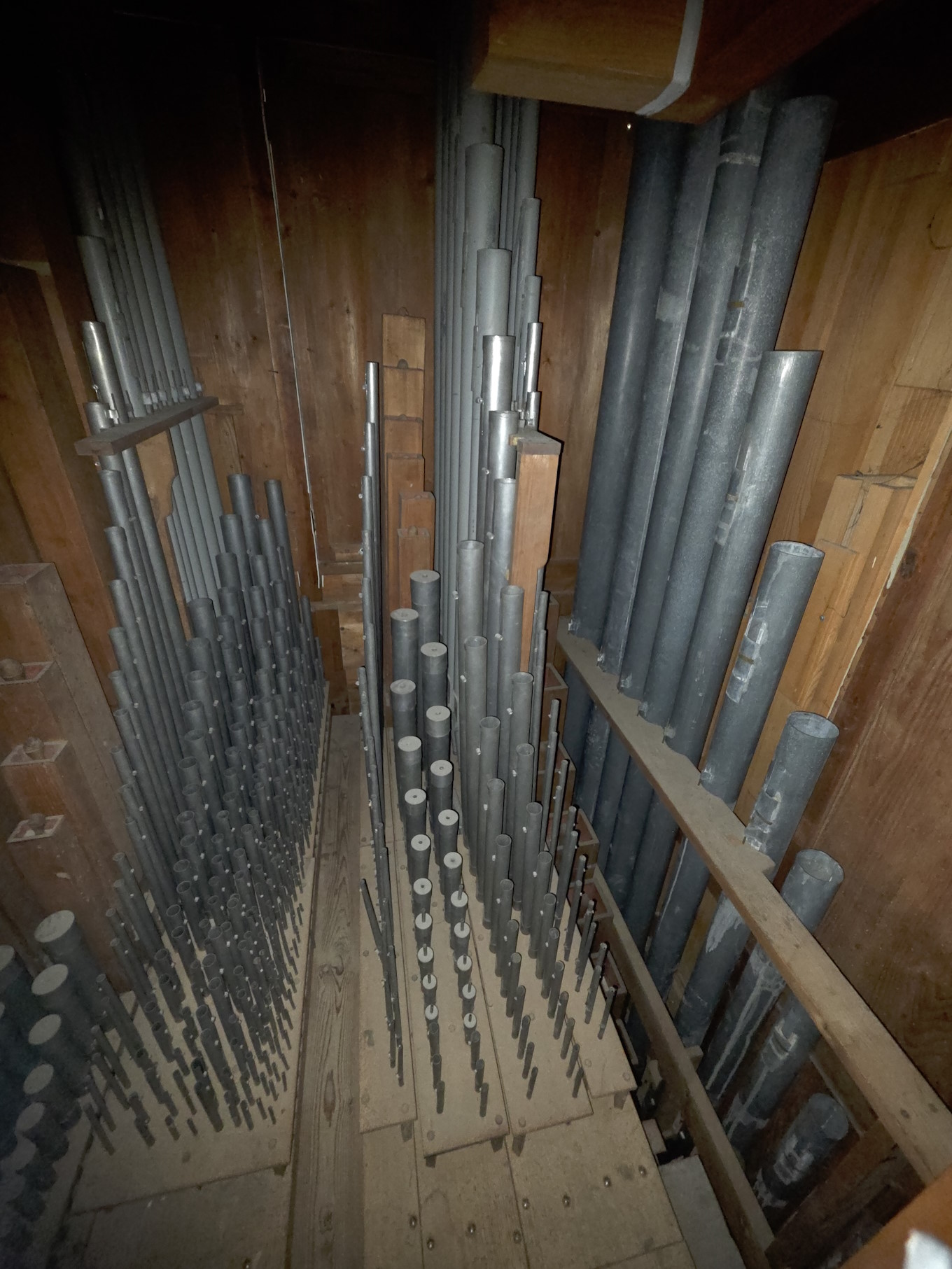
Photo: Organistica
Cleaning the organ
The organ is heavily covered in dust and therefore requires thorough cleaning. During the inspection, the extensive presence of mould was particularly noticeable. Mould is present throughout almost the entire interior of the organ, with the upper part of the organ case being the most severely affected.
The mould problem should be addressed as comprehensively as possible to ensure a long-term solution. All affected surfaces should be cleaned with a suitable mould-removal agent and subsequently treated with an appropriate protective impregnation to prevent further mould growth.
Voicing
The manual registers added in 2002 do not blend optimally with the original part of the organ in terms of their tonal character. The harder-sounding registers, voiced in a Neo-Baroque style, are not sufficiently compatible with the late-Romantic Rieger instrument due to their pronounced octave harmonics. We recommend that the voicer soften the “new” manual registers and adjust the harmonic structure appropriately, allowing the overtones to develop naturally rather than emphasizing the octave harmonics. An attempt should also be made to improve the tone of the Principalbass 16′ so that it provides adequate support for the overall tonal ensemble. To this end, it is advisable to raise the smaller pipes slightly, giving them more space around the mouths for proper sound development.
A particular challenge is the lack of 4′ registers in the organ. When the organ was enlarged, the fact that the original instrument had no independent 4′ register was not taken into account. The Oktava 4′ is an octave transmission of the Principal 8′, the Flöte 4′ of the Hohlflöte 8′, the Oktava 4′ of the Geigenprincipal 8′, and the Flöte 4′ of the Rohrflöte 4′. Consequently, no independent 4′ register was added. In the long term, it would be worth considering an appropriate replacement or addition, for example by introducing a new 4′ register in place of the added Superoktave 2′.
The organ consoles
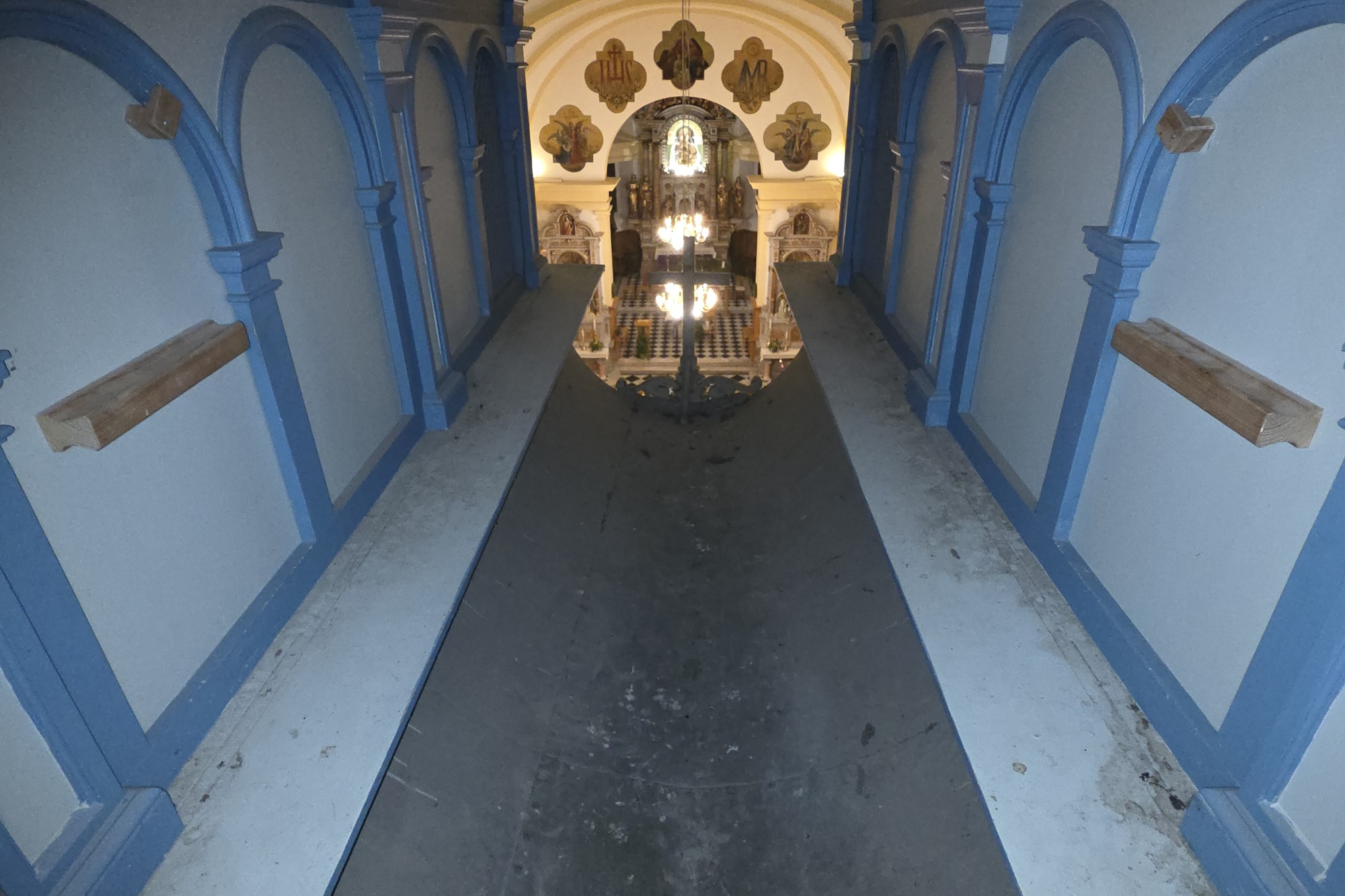
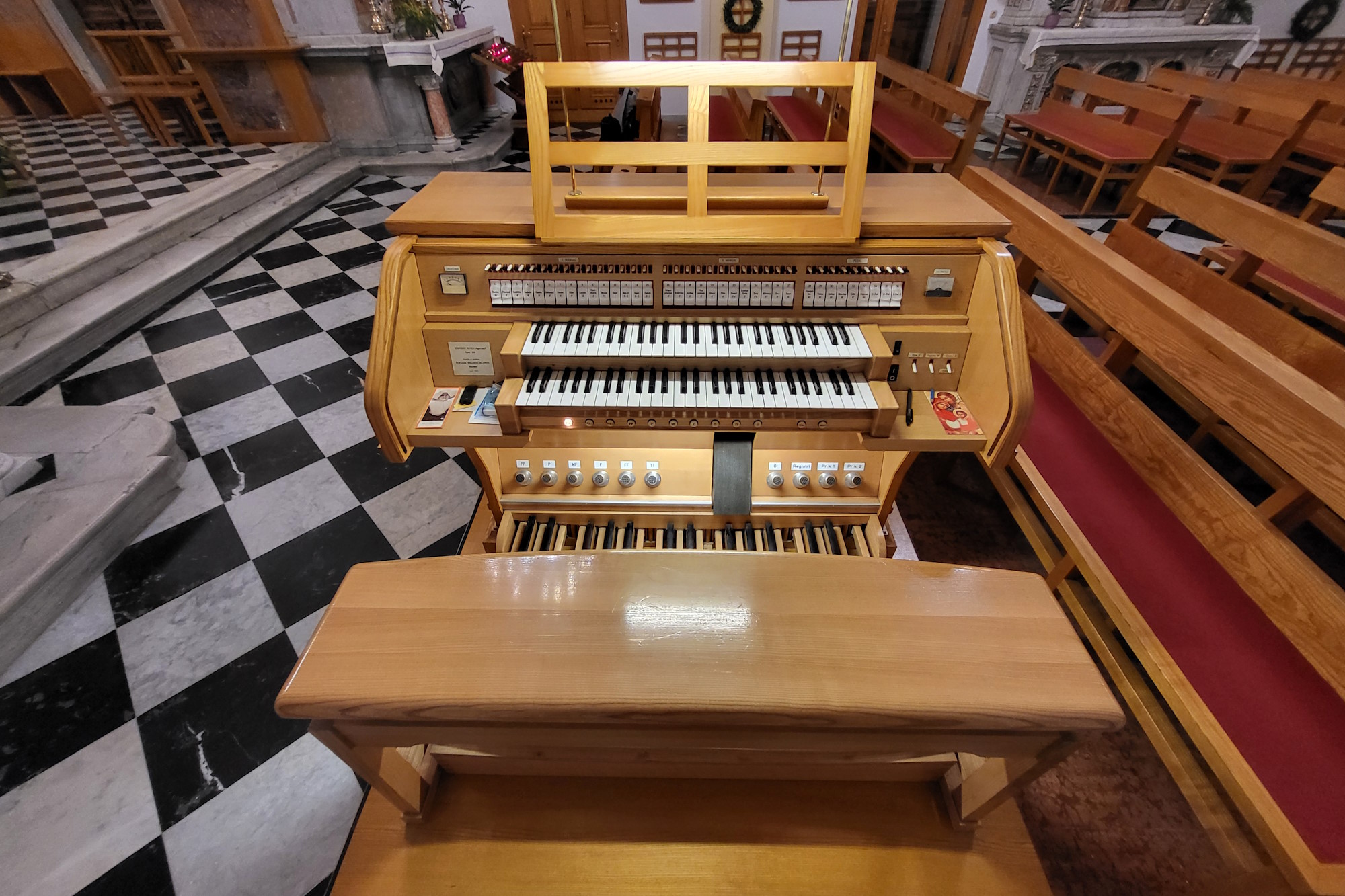
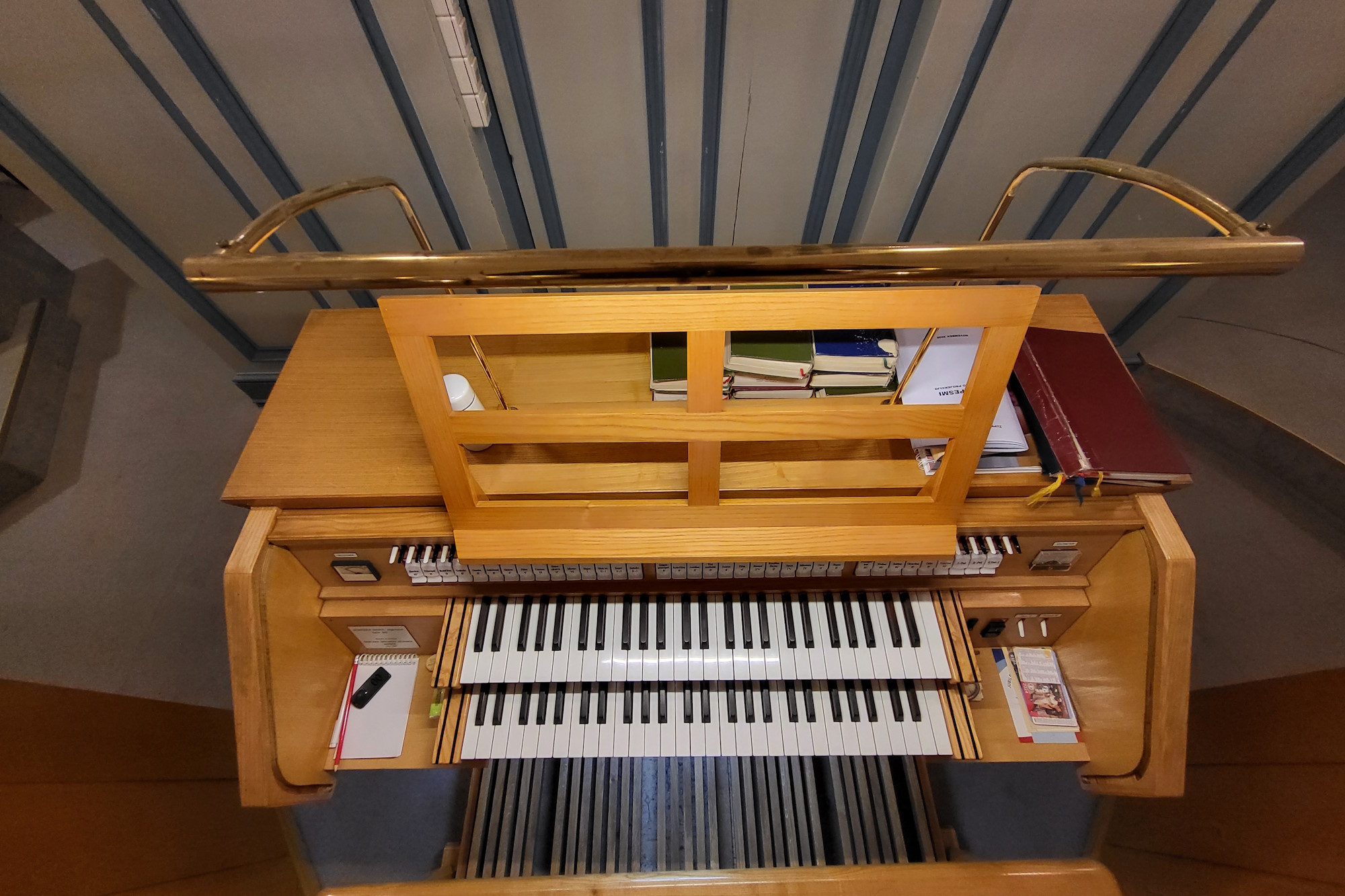
The organ has two electric consoles. The first is located on the gallery in front of the organ, with the organist facing the instrument, away from the altar. The second console is situated at the lower left-hand front of the church and is positioned at a 90-degree angle to the altar, facing towards it. This allows the organist to have a clear view of the church and the altar.
The tilting register switches are arranged above the second manual. As part of the work, the console could also be equipped with several useful additional features, such as an integrated projection system for displaying hymns, communication with the sacristy, a sound system for the organist, and a camera for monitoring services or concerts.
*The crescendo settings differ between the upper and lower consoles.
Lower console
On the Manual I, the fis2 key is not working on the following registers:
- Burdon 16′,
- Principal 8′,
- Hohlflöte 8′,
- Gedeckt 8′,
- Salicional 8′,
- Cornett II – III,
- Mixtur VI 2 2/3′.
On the Manual II, the dis2 tone on the Vox coelestis 8′ register sounds continuously without the key being pressed.
On the pedal, the dis1 tone on the Octavbass 8′ register sounds continuously without the key being pressed.
On the pedal, the following tones on the Pozavna 16′ register are not working: D, GIS, A, h0, f1.
When the Tutti fixed combination is engaged, the tones listed above sound continuously or “play” on their own.
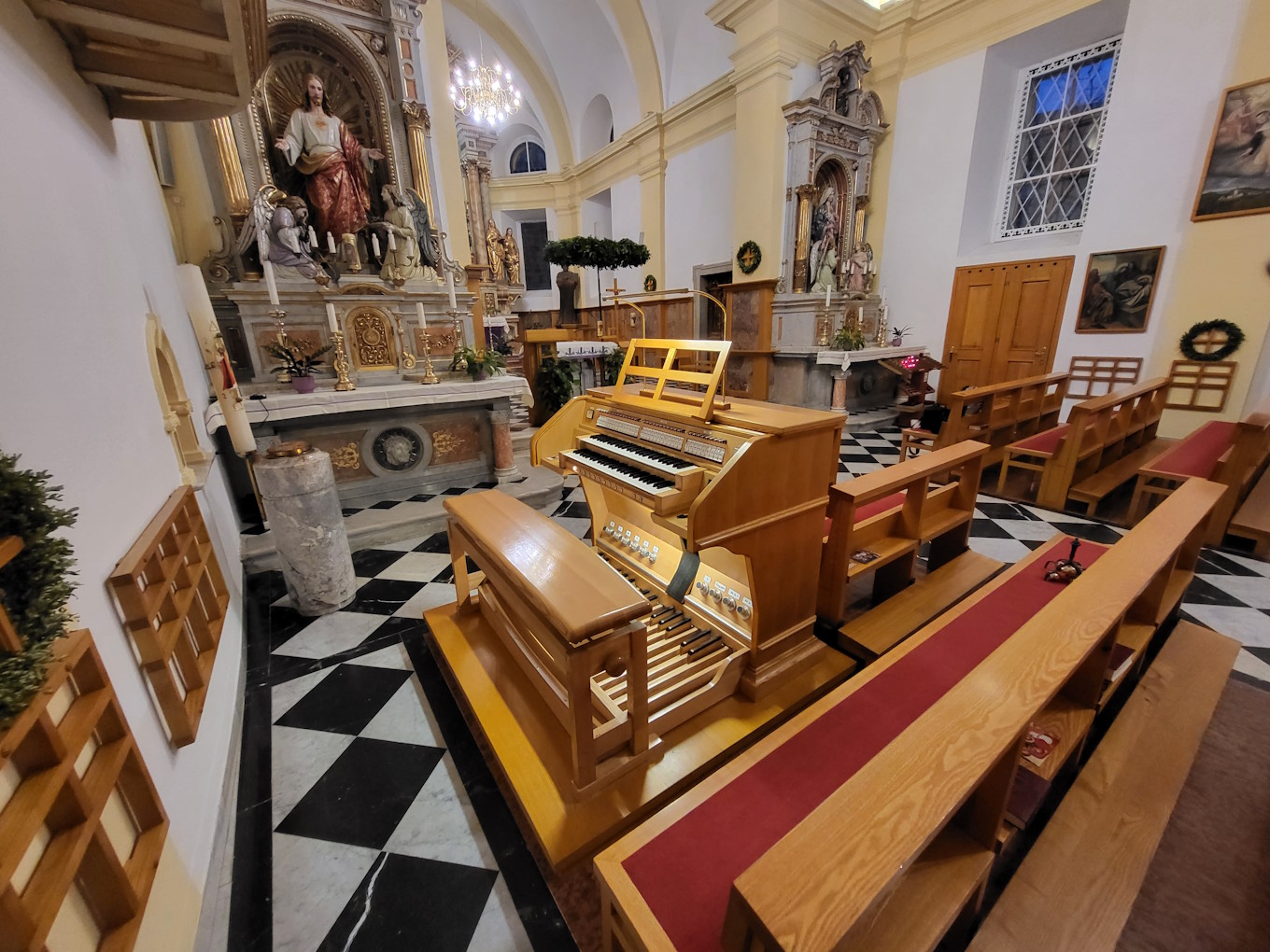
Photo: Organistica
Upper console
On the Manual I, the fis2 key is not working on the following registers:
- Burdon 16′,
- Principal 8′,
- Hohlflöte 8′,
- Gedeckt 8′,
- Salicional 8′,
- Cornett II – III,
- Mixtur VI 2 2/3′.
On the Manual II, the dis2 tone on the Vox coelestis 8′ register sounds continuously without the key being pressed.
On the Manual II, the tones (keys) from C to b2 are not working.

Photo: Organistica
Organ case
All load-bearing structures should be inspected to ensure their structural integrity and to verify that the timber members have been oriented appropriately with regard to the natural direction of wood grain. As part of the restoration, the doors should be inspected and properly repaired or adjusted, including those secured with organ latches or hinges.
Any inappropriate electrical wiring in the organ case and at the console should be removed. A suitable electrical installation should be provided, including lighting both inside and outside the organ case.
Damaged exterior paintwork and carved decorative elements should be appropriately restored. In addition, the organ case should be thoroughly cleaned both inside and out.

Photo: Organistica
Rieger’s organ as a witness to history and liturgical practice
The organ in the parish Church of St. Joseph in Celje is more than a musical instrument; it is a living witness to the history, technological development and liturgical practice of a particular place. Its sound carries the spirit of the period in which it was built, while at the same time engaging with and contributing to the present day.
Over more than a century of existence, the Rieger organ has experienced admiration, criticism, technical challenges, restoration and enlargement. Church musicians, organ builders and priests have all played a role in decisions concerning the instrument and reflected on its future, each from their own perspective, yet with the same concern: how to preserve its heritage while at the same time adapting it to contemporary needs.